Sydney Sports Physio: After 18 Years Watching Aussies Get Stuck in the Same Loop, I Stopped Doing Things the Textbook Way.
Why thousands of Australians over 50 with chronic lower back pain and sciatica are quietly walking away from the GP-physio-specialist loop - and what one Sydney sports physio started doing at home that the public system never gets around to.
By Brendan Walsh, Sports Physiotherapist (BAppSc), Sydney NSW | Published 13 May 2026
Look, this is going to annoy a few of my colleagues. But after twenty-five years working with everyone from Wallabies forwards to seventy-year-old grandmothers in Sydney's northern suburbs, I've got to call it.
The way we manage chronic lower back pain in Australia is broken.
Not the acute stuff. If you've had a sudden disc bulge or a workplace injury, the system handles you reasonably well. You see a GP, you get a referral, you do your rehab, you mostly get back to normal.
I'm talking about the long-term, grinding, won't-go-away kind of back pain. The sort that makes you feel ninety getting out of bed. The sort where the pain starts in your lower back and shoots down your leg like someone's dragging a hot wire from your arse cheek to your ankle.
If that's you, you already know what I'm about to say.
You've done physio. Maybe chiro. You've had heat packs and TENS pads and that bloody foam roller your daughter bought you. You've had the GP say "let's try anti-inflammatories" for the fourth time. Maybe you've had the orthopaedic specialist tell you to "live with it until it gets worse" before they'll consider surgery.
And you've done it all without ever fixing the actual thing that's causing the pain.
The Moment I Stopped Believing The Textbook
About four years ago, I watched my wife Karen go through the worst eighteen months of her life.
She'd been a primary school teacher in regional NSW for thirty-one years. Bending over kids' tables. Lifting boxes of resources. Standing on concrete all day. By her late fifties, the pain was constant.
One night I found her on the bathroom floor at quarter past two in the morning. Not crying. Just sitting there with her back against the cold tiles, staring at nothing.
"I can't do this anymore, Bren. I can't live like this."
The pain had been shooting down her right leg for six days straight. She wasn't sleeping. She was popping Panadol Osteo like lollies. She'd already tried everything our system offers a woman in her late fifties with chronic sciatica.
- Her GP had run her through the standard pathway. Anti-inflammatories. Physio referral. Imaging. More physio.
- The physio used the five Medicare-subsidised sessions she got under her Chronic Disease Management Plan. Then she had to start paying out of pocket. Eighty dollars a visit. Twice a week. The relief lasted about as long as the drive home from the clinic.
- Her chiro charged ninety bucks a crack. Same story.
- The orthopaedic specialist in Sydney suggested a cortisone injection. That bought her about six weeks. Then it came back worse.
- When she asked about surgery, he said the public waitlist in NSW was eighteen months minimum. Private would cost the better part of twenty thousand dollars out of pocket.
That night on the bathroom floor, I just stood there. A sports physio who couldn't help his own wife.
And I started to question everything I'd been taught.
What I Found When I Actually Sat Down And Read The Research
For the next three months I went back to basics.
I rang colleagues in Melbourne and Brisbane. I went through old textbooks. I read research papers I hadn't looked at since university. I even tracked down a Swedish study from 1987 that's been quietly sitting in the literature for nearly forty years.
And here's what hit me.
Most of what we do in mainstream Australian physio for chronic lower back pain is built around one model: strengthen the core, improve flexibility, manage inflammation. That's the textbook.
It works for some people. For a lot of older Australians with years of compression in their lower spine, it doesn't.
Why? Because by the time you're in your fifties or sixties, the problem often isn't weak muscles or tight hamstrings. It's something more mechanical.
Picture your spine like a stack of jelly donuts.
Each vertebra is a donut. The disc between each one is the jelly filling. When you're young, those discs are plump and full of fluid. They keep your bones apart and give your nerves the space they need.
After about age thirty, those discs slowly start to flatten. Years of standing, sitting, lifting, driving, carrying kids and grandkids and shopping bags - it all compresses the spine downward. Gravity wins. The discs get thinner. The bones come closer together. The little holes that your nerves run through get smaller.
And eventually, the sciatic nerve in your lower back has nowhere to go. It gets compressed like a garden hose pinned under a ute tyre.
That's the burning. That's the pain shooting down the leg. That's the numbness in the foot. That's the "crook back" that won't go away no matter how many core exercises you do.
That 1987 Swedish study found significant disc compression in the vast majority of long-term sciatica sufferers they scanned. Forty years later, most of us in mainstream physio are still treating the muscles around the problem instead of the compression that's causing it.
Why The System Doesn't Fix This (And Probably Never Will)
Here's the bit that took me a while to accept.
If decompressing the lower spine is one of the things that helps with chronic compression-related back pain, why isn't it the standard of care in Australia?
Because the system isn't set up for it.
- Medicare pays for five subsidised physio visits a year under a CDM Plan. That's not enough to manage anything chronic. After that, you're paying eighty to a hundred dollars a session out of pocket.
- Private health extras cover wears out fast. Most of my older patients hit their annual cap by August.
- Decompression-style traction takes time and consistency. Once or twice a week at a clinic isn't enough. But twice a week at eighty bucks a pop adds up to thousands a year. Most retirees on a pension can't do that.
- The public surgery waitlist in most states is brutal. One to three years isn't unusual for a non-urgent spinal procedure.
- Private surgery is twenty grand out of pocket on a good day. And most people my wife's age don't actually want to be cut open. They want to live well at home.
So what happens? You get stuck in the loop. GP, physio, GP, physio, specialist, "live with it," rinse and repeat. And every time you try something new, it works for a week or two, then you're back to where you started.
I got tired of telling patients to just keep doing their stretches.
What We Started Doing At Home Instead
Once I'd gone deep on the research, the way forward was actually pretty straightforward.
If the compression is the problem, you need to do three things to address it - not just one.
- Decompress. Gently create space between the vertebrae. Even a few millimetres of separation can take pressure off the nerve.
- Soothe. Apply targeted warmth to the lower back area. Heat increases blood flow to the area, helps the muscles relax, and supports the soft tissue while it's being decompressed.
- Reset. Gently massage the muscles either side of the spine. Years of guarding and protective tension don't go away on their own. Targeted massage helps the muscles let go and stop pulling everything back into the compressed position the moment you stand up.
That's the part that took me a while to get my head around.
Most products tackle one of those three. A heat pack does warmth. A foam roller does massage. An inversion table does decompression. But none of them does all three at once.
And on their own, none of them really moves the needle for someone with twenty years of accumulated compression.
The Device That Pulled It All Together
About eighteen months ago a colleague in Brisbane showed me a device that does all three at once.
It's called the Mendable Triple Fusion Massager. You lie down on it for fifteen minutes. The shape of it is what does most of the work.
Here's what actually happens during a session.
0 to 5 minutes - Decompression. The contoured shape sits under your lower back and creates gentle, targeted traction. Most people feel a small release in the first thirty seconds - almost a quiet release in the lower back.
0 to 5 minutes - Decompression. The contoured shape sits under your lower back and creates gentle, targeted traction. Most people feel a small release in the first thirty seconds - almost a quiet release in the lower back.
0 to 5 minutes - Decompression. The contoured shape sits under your lower back and creates gentle, targeted traction. Most people feel a small release in the first thirty seconds - almost a quiet release in the lower back.
You get up. You feel taller. You feel like your lower back has had the kind of session you used to pay a hundred dollars an hour for at the physio.
Karen used it twice a day for the first month. Now she does fifteen minutes most evenings while she's watching the news.
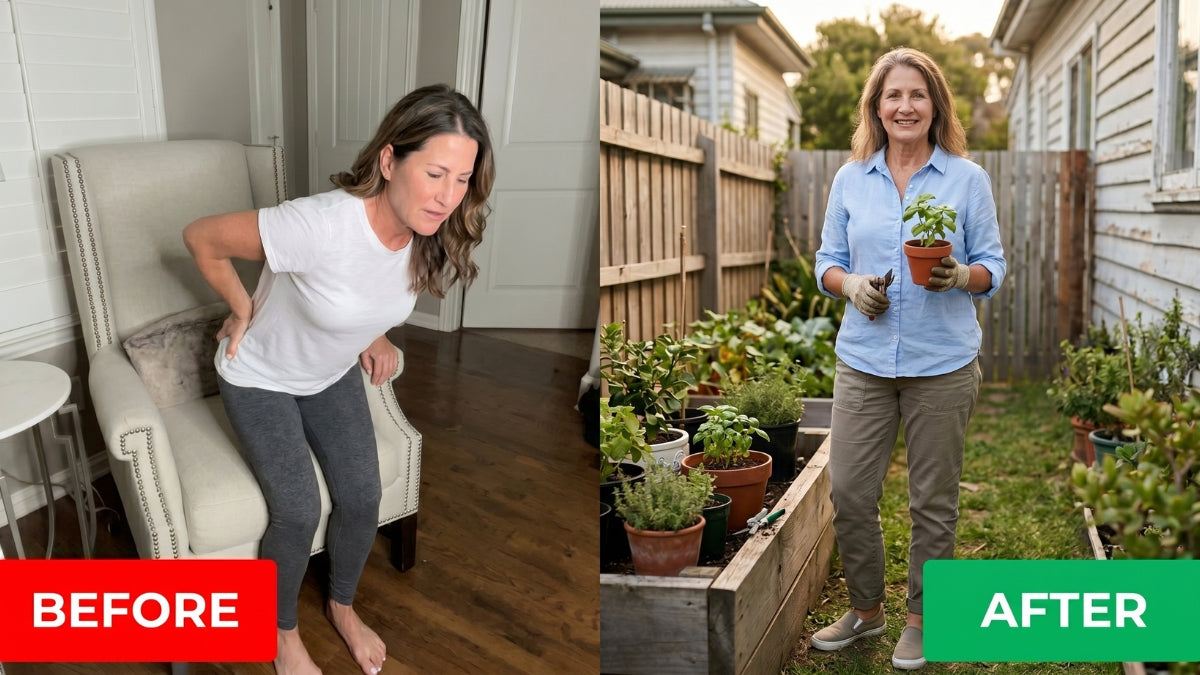
She's back in her garden. She's sleeping through the night. She still has the occasional flare-up - this isn't a miracle - but the difference between where she was four years ago and where she is now is the difference between being trapped in a body and living in one.
The Australians Quietly Using It Every Day
Once Karen started seeing real changes, I quietly started recommending it to patients who'd been stuck in the loop for years.
Here's a sample of what they've told me, in their own words.
Forty years on the tools. My back was absolutely buggered. Fifteen minutes on this thing of an evening and I am actually sleeping through the night for the first time in eight years.
- Kev, 67, retired builder, Toowoomba QLD
Forty years on the tools. My back was absolutely buggered. Fifteen minutes on this thing of an evening and I am actually sleeping through the night for the first time in eight years.
- Kev, 67, retired builder, Toowoomba QLD
Forty years on the tools. My back was absolutely buggered. Fifteen minutes on this thing of an evening and I am actually sleeping through the night for the first time in eight years.
- Kev, 67, retired builder, Toowoomba QLD
Forty years on the tools. My back was absolutely buggered. Fifteen minutes on this thing of an evening and I am actually sleeping through the night for the first time in eight years.
- Kev, 67, retired builder, Toowoomba QLD
These aren't cherry-picked. They're the kind of feedback I've been hearing every week for over a year now.
What This Actually Costs You In Australia - And What It Doesn't
Let me show you what most older Aussies end up spending on chronic lower back pain every year.
Against any of those numbers, the cost of a Mendable Triple Fusion Massager is - honestly - not the point. The point is that it's a tool you own and use at home, every single day, for as long as you need it. No appointments. No driving. No gap fees.
And right now, because of the End of Financial Year sale, Mendable have knocked the price down significantly.
The EOFY Sale - And Why I'm Telling You About It Now
I don't normally write about products. But Mendable have run a serious EOFY sale this year, and they've asked a handful of Australian physios and writers if we'd be willing to share it with our readers.
For the EOFY 2026 promotion, they've dropped the price from the regular $449 down to $179 for a single unit, or $299 for the two-pack (which works out to $149.50 each). Most couples or households get the two-pack - one for the lounge room, one for the bedroom - or they buy a second one as a gift for a parent or sibling.
Every order also comes with three free extras: a 30-day lower-back routine guide written for older Aussies, a travel and storage bag, and a pack of twelve heat patches for the days when you want extra warmth.
Shipping is included, dispatched from their Australian warehouse, usually arriving within seven working days anywhere on the mainland.
The EOFY sale ends 30 June. After that, the price returns to $449.
Check Availability & Pricing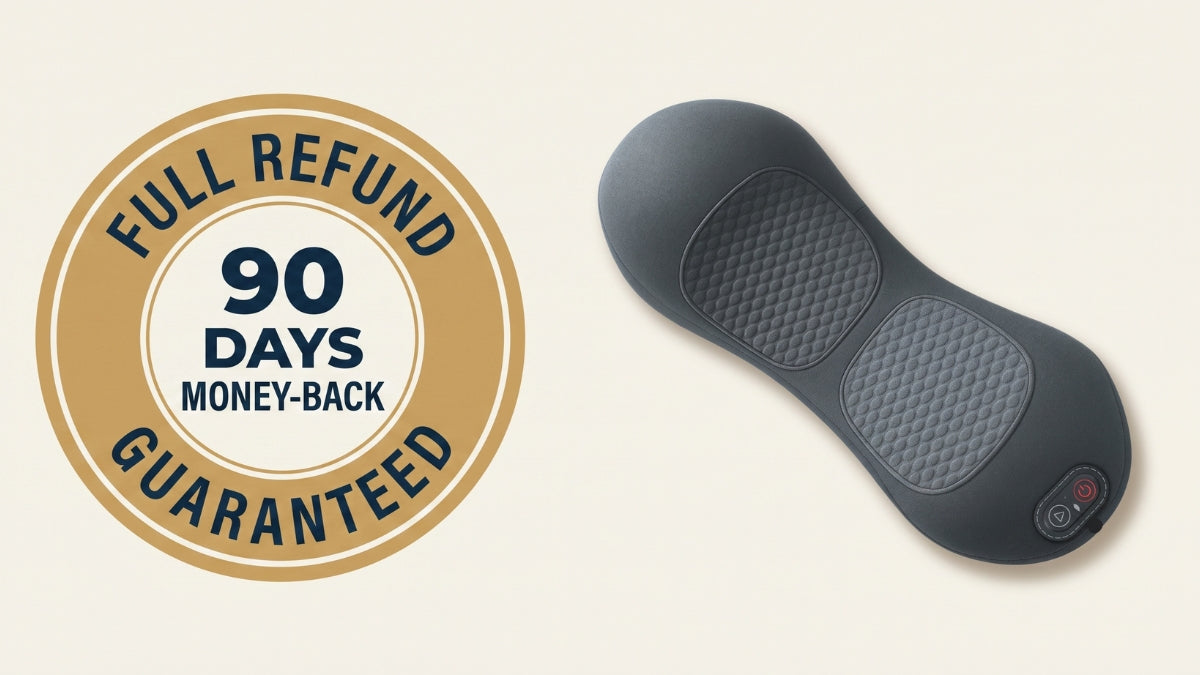
The 90-Day Guarantee - And Why It Matters
Look. I get the scepticism. Australians have seen enough overhyped American pain devices to last us a lifetime. The default response to anything that says "3-in-1 back relief" is "pull the other one."
Which is why the only reason I'm comfortable putting my name to this is that Mendable do an actual 90-day money-back guarantee.
You use it for ninety days. Daily. Twice a day if you want. If you don't notice a real change in how your lower back feels - not magic, just a real change - you email their Australian support, they send a return label, and they refund you in full.
No forms. No store credit. No "sorry, you didn't use it correctly" runaround.
Your statutory rights under Australian Consumer Law are not affected by any of this. The guarantee sits on top of what you're already entitled to as an Australian consumer.

What I'd Tell You If You Were Sitting In My Clinic
If you're reading this with a heat pack pressed against your lower back, or you're thinking about the bathroom floor at three in the morning, here's what I'd say.
You've got two paths.
Path one: keep going through the loop. Another year of physio sessions that help for forty-eight hours. Another round of anti-inflammatories. Another wait on the surgical list. Another twelve months of waking up with your spine feeling rusted shut and going to bed hoping tomorrow's a better day.
Path two: get a tool you can use at home, every day, for the next ten or twenty years of your life, that addresses the actual mechanical problem instead of just the muscles around it.
That's it. That's the choice.
I'm not saying this device is a cure. It's not. There is no cure for the way the spine ages. But there are tools that help, and after watching my own wife come back from where she was four years ago, this is the one I trust enough to put my name to.
The EOFY sale ends 30 June. The link below takes you straight to the Mendable site to check current pricing and availability.
P.S. Karen still uses it most evenings. She did fifteen minutes last night while we watched the cricket. She is sixty-three now and back in her garden every weekend. That is not a sales pitch - that is just where we have ended up.
P.P.S. Mendable warehouse is in Sydney. Their support team is in Australia, contactable 9 to 5 AEST. Their 90-day guarantee is in writing. None of that is a guarantee that the device will work for you specifically - bodies are different - but it does mean that if it does not work for you, you are not stuck with it.
P.P.P.S. If the EOFY price has already returned to $449 by the time you click through, that is the sale ending. They have told me they only run it once a year.
EOFY 2026 Sale - Available While Stocks Last
See Pricing & Bundles
Medical & Health Disclaimer. The content above is general information and personal opinion from a practising Australian physiotherapist and is not intended as medical advice, diagnosis, or treatment for any specific health condition. The Mendable Triple Fusion Massager is a wellness product designed for at-home use and is not a registered therapeutic device. Individual results vary. If you have chronic pain, a diagnosed spinal condition, osteoporosis, are pregnant, or are recovering from spinal surgery, please consult your GP or registered physiotherapist before using any decompression-style device. Nothing in this article is intended to delay, replace or substitute professional medical care. Your rights under the Australian Consumer Law are not affected by any guarantee offered by the manufacturer.
Disclosure. The Aussie Body Report features partner products and may earn a commission on purchases made through links in our coverage. Our editorial independence and the views of contributing writers are not affected by this arrangement.