Advertisement
mendable
Insights
Home > Health > Legs & Circulation

Top Vascular Specialist: "This Is the Fastest Way I've Found to Relieve Swollen Legs"

Friday, 10 July 2026 | 14 min read
WARNING:

Don't read another word until you've done this. Press your thumb hard into the inside of your ankle. Hold it while you count to five. Lift it off. If the dent is still sitting there, everything you have tried for your swelling has been aimed at the wrong place in your body. I'll show you where it actually is.

I'm about to make myself slightly unpopular with a few people in my own profession.

Not because what I'm going to tell you is controversial. It isn't. Any vascular doctor in this country would agree with every word of it, and most of them would be pleased somebody finally wrote it down.

The problem is that it takes about six minutes to explain properly.

And the average GP consultation in Australia runs a shade under twenty minutes, in which there is blood pressure to do, and scripts to write, and the other thing you came in about.

So it doesn't get explained. Almost ever.

And because it doesn't get explained, several million Australians are spending money — real money, year after year — on things that were never going to work. Not might not. Never. Not because the things are rubbish, but because they are pointed at a part of your body where the problem isn't.

I've watched people do it for my whole working life.

I look at the veins in people's legs for a living.

THE PLASTIC BAG

Three or four times a week, somebody sits down in the chair across from me and puts a plastic bag on my desk.

Chemist bag, usually. Woolies bag sometimes.

And they tip it out.

SHOT 2 — THE BAG, TIPPED OUT

Two boxes of fluid tablets. A pair of compression stockings, still in the packet, because they couldn't get them on. Another pair, worn out, that they did get on, for about eight months. A tube of something. A little foot massager, the kind you see advertised late at night.

And they look at me, and they say some version of the same sentence.

"I've tried everything. Is this just how it is now?"

I want you to understand something about that moment, because I think it's the saddest thing in my job.

Nothing in that bag was stupid. Every single item in it was recommended by somebody sensible. The tablets came from a GP who was quite right to prescribe them. The stockings are genuinely good medicine. Elevating your legs works, as far as it goes.

And the person holding the bag has done everything they were told, for years, with real discipline.

Their ankles still go by three o'clock every afternoon.

They still keep a pair of shoes for the evenings — the stretched ones, the ones they'd never wear out of the house — because the good ones stopped going on somewhere around lunchtime.

They still peel a sock off at night and find a groove cut into their shin so deep you could read it like a tide mark.

SHOT 3 — THE SOCK MARK

And there's a bone on the outside of the ankle that they haven't seen in years.

They didn't fail.

They were aiming at the wrong place.

WHAT THE BAG ACTUALLY DID

Let me go through it, item by item, the way I do across the desk.

SHOT 4 — SIX THINGS THAT DIDN'T WORK
  • The fluid tablets — They sent you to the toilet all day and got you up again at two in the morning. Your ankles were possibly a little better by lunch. By four they were back.
  • The compression stockings ($60–$80 a pair) — A two-person job to get on of a morning. They cut a red line into your calf all day, they lose their squeeze inside six months, and the moment they come off in the evening, nothing underneath them has changed by so much as a millimetre.
  • The pillow under your feet — That's gravity, borrowed. You get about an hour. Then you stand up.
  • The salt — You took the shaker off the table and stopped enjoying your dinner. Your ankles did not notice.
  • The physiotherapist ($90–$100 a session) — Good advice, delivered by somebody who knew what they were talking about. Not the thing.
  • And the little massager — It buzzed. It was quite pleasant for ten minutes. It's under the bed now, isn't it.

Six things. Somewhere north of two thousand dollars, for most people who've been at this five or six years.

And six years of afternoons planned around your feet.

Not one of them was aimed at where the fluid actually is.

Now let me show you where that is.
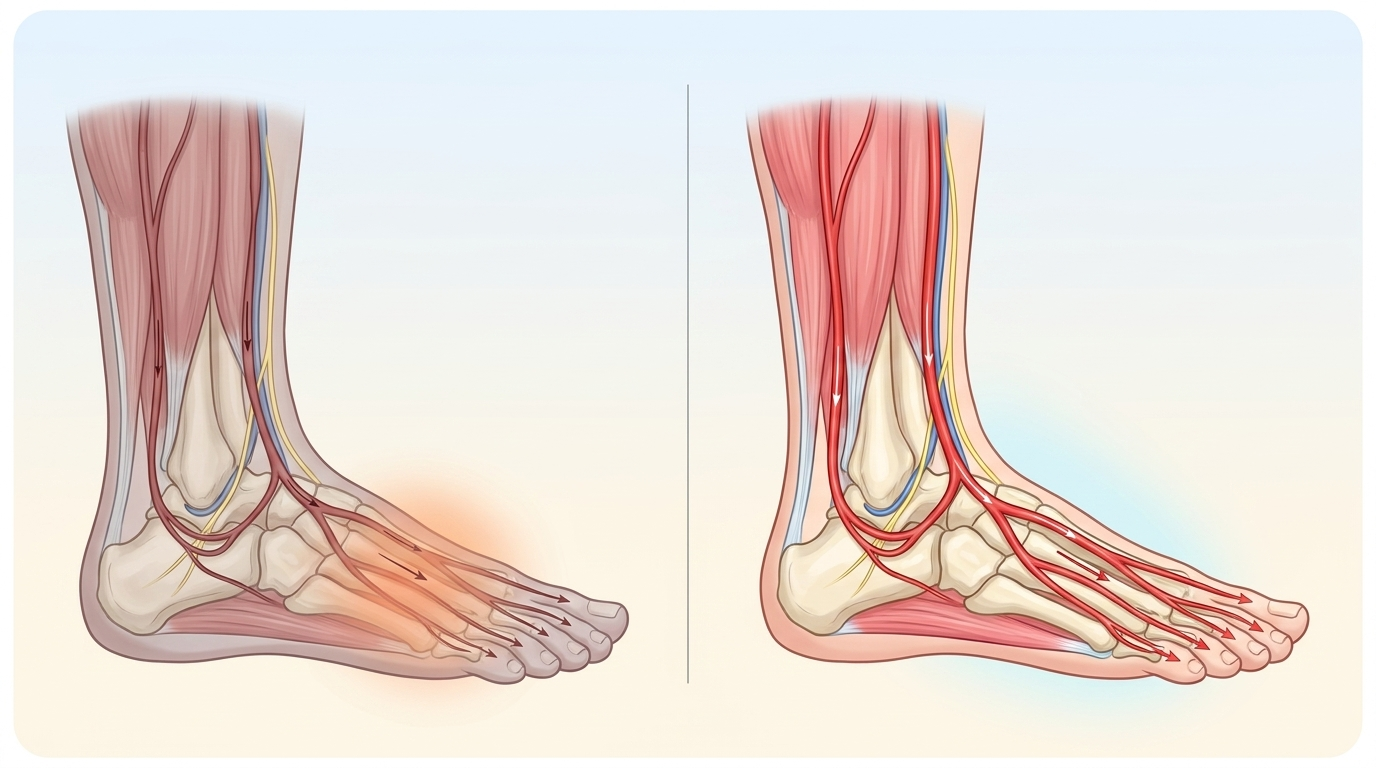
THE PART NOBODY HAS TWENTY MINUTES TO DRAW FOR YOU

Getting blood down to your feet is free.

Gravity does the whole job. Your arteries barely have to try.

Getting it back up to your heart is the fight of your life.

Your veins have to lift that blood, against gravity, the entire way, every second that you are standing up. And they haven't got a pump of their own. Your heart is at the top. It can pull. It cannot reach down there.

So the veins in your legs have help.

BLOOD GOES UP
The door opens upward
THE DOOR SHUTS
Blood can't fall back down
AFTER 50 YEARS
It sags. Blood leaks back.
Every few centimetres, a vein has a one-way door. About a hundred thousand of these open and shut in your legs between waking up and going to bed.

Every few centimetres, there is a one-way valve. Picture a small door that only opens upward. Blood pushes through it going up, the door snaps shut behind it, and the blood cannot fall back down.

Those doors are made largely of a protein called elastin. Same stuff that makes young skin spring straight back when you pinch it.

Now — every time you take a step. Every time you shift your weight in a chair. Every time you get up off the lounge. The muscles in your calf squeeze the vein, blood goes up, the door snaps shut behind it.

About a hundred thousand times between waking up and going to bed.

Do that every day. For fifty years.

You know exactly what happens to a rubber band that's been sitting in the kitchen drawer since the eighties. You stretch it, and it just… stays stretched.

It's lost its snap. It doesn't come back.

That is what happens to elastin.

After forty, fifty years — sooner if you've been pregnant, sooner if you've stood up for a living — those doors stop slamming. They sag. They don't quite close.

And blood that ought to be travelling north starts sliding quietly back down.

It pools in the lowest place it can reach.

Which is your feet and your ankles.

AND POOLED BLOOD IS HEAVY

This is the sentence I wish somebody would put on the wall of every waiting room in the country.

Pooled blood presses outward against the wall of the vein. All afternoon. With real, physical, measurable force.

Press hard enough on a vein wall for long enough, and the watery part of the blood is squeezed straight out through it — into the flesh around your ankle.

That is your swelling.

SHOT 5 — 7 AM / KNOCK-OFF — SAME ANKLE

Not water you drank. Not salt you had with your chops. Not "getting older."

It is fluid that has already left your bloodstream, and is now sitting in the tissue of your lower leg.

That is why, when you press your thumb into it, the dent stays. There is nothing underneath to push it back out.

And it is not rare. Published prevalence figures put chronic venous insufficiency at somewhere between one in four and two in five Australian women, and roughly one in ten men. It rises steeply after forty. It is one of the most common vascular conditions in this country.

There are millions of Australians pressing a thumb into their ankle tonight.

WHICH IS THE EXACT REASON A FLUID TABLET DOES NOTHING

Look at what the tablet actually does.

It travels to your kidneys and it gives them one instruction: pull water out of the blood and send it to the bladder.

Out of the blood.

But the fluid that made your ankles disappear is not in your blood any more.

It is out in the tissue.

The tablet cannot reach it. It was never able to reach it. It was never designed to reach it. It empties your bloodstream — which is precisely why you're awake at two in the morning — and it leaves the swelling exactly where it was.

You have been treating the wrong place this entire time.

Now hold that one sentence in your hand and go back through the plastic bag.

The stockings hold. They don't move. A constant, unchanging squeeze, all day. They are excellent at stopping tomorrow from being worse. They do nothing whatsoever about what is already out there today.

The pillow. Gravity, on loan, for an hour.

The salt. Changes what goes in. Does nothing about what's already out.

The massager under the bed. It vibrated. That is one of three jobs — and it happens to be the last one.

Every one of them did a fraction of what needs doing.

Which is exactly why not one of them ever finished it.

THERE ARE THREE JOBS. THEY HAVE TO BE DONE AT THE SAME TIME.

If you want fluid to come out of the tissue and go back where it belongs, you must do three things, together, in one sitting.

SHOT 6 — THE UPWARD STROKE

WARMTH

Swollen tissue is tight tissue. It's under pressure and it resists being moved. Gentle heat opens the vessels and softens the tissue, so that it is willing to give up what it's holding.

RHYTHM, NOT PRESSURE

This is where the stockings go wrong, and it's the single most important thing on this page. A stocking squeezes and holds. What actually moves fluid out of tissue is a squeeze that lets go, and squeezes again, and lets go — travelling upward, in a wave, the way a hand would if somebody were patiently milking the fluid back up your leg. Holding is not moving. It never was.

WAKE THE PUMP

You have a muscle pump around your ankle and in your calf. We call it your second heart, and it is the thing that genuinely pushes fluid upward. In legs that sit still, that pump goes quiet. Vibration switches it back on, so that what you have just moved doesn't slide straight back down the moment you stand up.

Miss any one of the three and you are doing what you have already been doing for six years.

Do all three, at once, for fifteen minutes — and for the first time in your life, the fluid actually goes somewhere.

That's why I said the fastest way I've found. Not because it is aggressive, or clever, or expensive.

Because it is the only thing I've come across that is aimed at where the fluid actually is.

THE DEVICE BUILT AROUND THOSE THREE JOBS

Warmth
Softens the tissue
Rhythm
Moves the fluid upward
Pump
Keeps it from coming back

It's called Mendable Foot Restore.

SHOT 7 — THE WRAPS, WORN

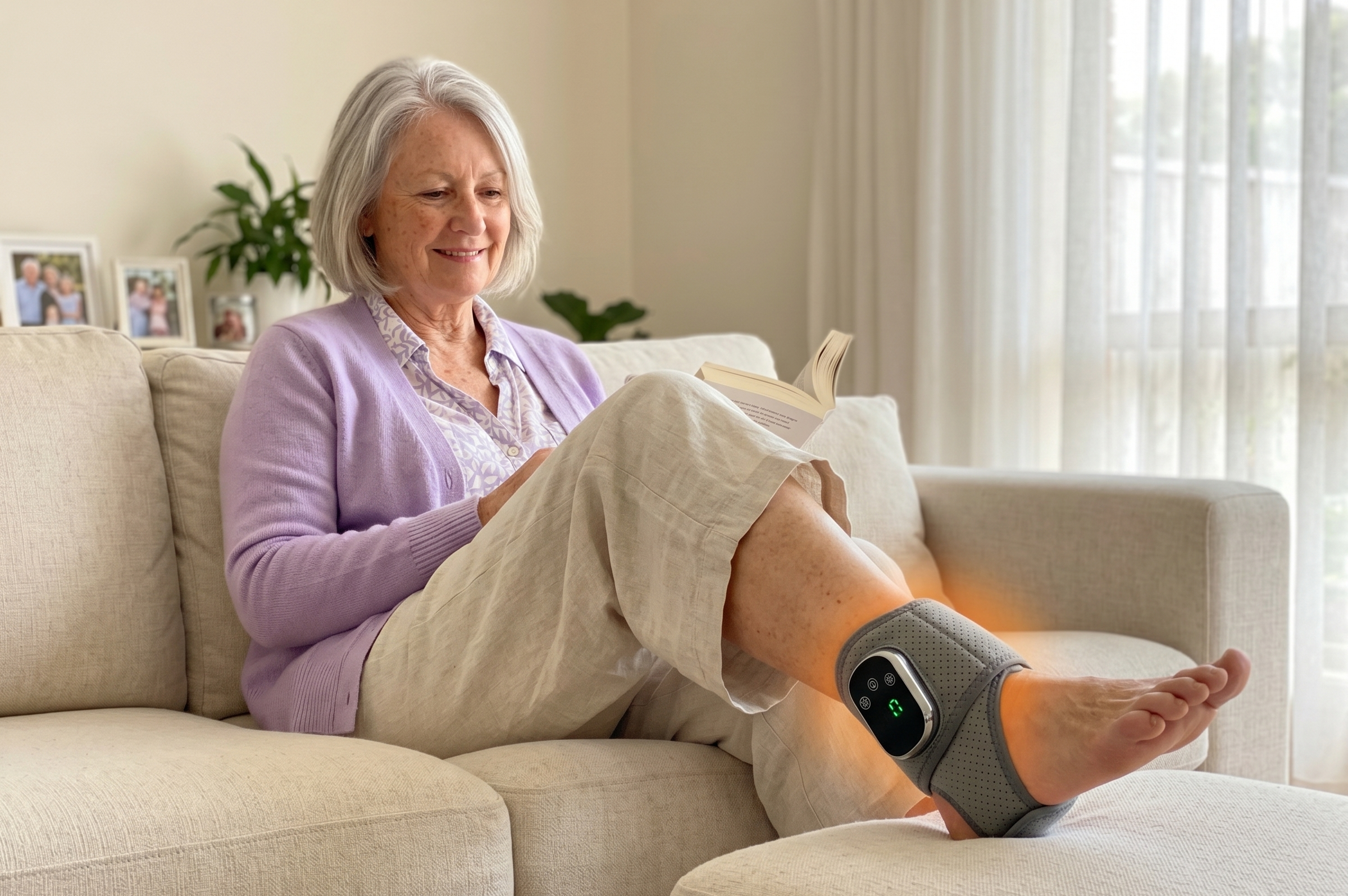
A soft grey wrap. It goes around your foot and your ankle — precisely where the fluid sits. One button. Fifteen minutes, in your own armchair, with the telly on.

Inside it, running together in the one session: warmth, rhythmic air compression, and vibration. They call it the Triple Method. That isn't a feature list. It's the three jobs, and they only work as a set.

Designed in Australia. Out of a Sydney warehouse within twenty-four hours.

EXACTLY WHAT HAPPENS IN THE FIFTEEN MINUTES

SHOT 8 — IN THE ARMCHAIR

Minutes 1–5: The Warmth

The heat comes up gently. It reaches 45 degrees and not one degree further, because there is a temperature sensor inside the wrap whose entire job is to stop it there.

I want to tell you why that number is on this page instead of buried in a manual.

A great many people with badly swollen feet also have feet that no longer register heat properly. If you cannot feel it, you cannot tell it to stop. There are wraps sold in this country that run to sixty degrees for half an hour, and they have no business being strapped to an ankle like yours.

This one physically cannot go there. That was a design decision, and it cost something to make.

Minutes 5–10: The Rhythm

The compression starts. Squeeze — release — squeeze — release, working upward in a wave.

This is the part that does the actual work. This is the part your stockings never did, because a stocking holds and a wave moves.

And this is the part people struggle to describe accurately, so let me try: your legs go light. Not numb. Not pressed. Light. Most people notice it inside the first session, and most people are quietly astonished at how much weight they had simply stopped noticing.

Minutes 10–15: The Pump

Vibration, through the muscles around the ankle and under the arch of the foot. Waking the second heart.

This is the part that decides whether tomorrow afternoon looks anything like today's.

Then it switches itself off. You unstrap it, and you get on with your evening.

SEE THE PACKS & PRICING → Free AU shipping · 90-day money-back guarantee

THEY PUT A TAPE MEASURE IN THE BOX

When they first showed me this, that is the thing that made me pay attention. Not the wrap.

Anybody can tell you their device works.

SHOT 9 — MEASURE. WRITE IT DOWN.

In every box there is a paper tape measure and a tracker card.

Tonight, before anything else: measure around your ankle. Write the number on the card.

In thirty days: measure again.

Not do you feel a bit better. Not is it probably a little less puffy. A number. In centimetres. In your own handwriting. It either moved or it didn't.

Measure at knock-off, by the way. Not first thing in the morning. Your ankle at seven a.m. is not the ankle that has been ruining your afternoons.

They are handing you the instrument to check up on them, and they'd rather you used it. In my experience that is not how this industry behaves.

And one more thing that tells you whether a company has ever actually met somebody with a swollen ankle.

Nearly every wrap sold in this country is "one size."

Your ankle is not one size. Your ankle being larger than a normal ankle is the entire reason you are reading this.

202836
CENTIMETRES
  • The wrap on its own — fits an ankle of 20 to 32 centimetres.
  • With the extension strap , included in every box — up to 42 centimetres.

Nobody gets left out. In this category, that should be unremarkable, and somehow it isn't.

THREE THINGS I AM NOT GOING TO TELL YOU

Be extremely careful of anybody who tells you otherwise. Including me.

I am not going to tell you to stop your fluid tablets.

Your GP put you on them for a reason. For some people that reason is their heart, or their kidneys, and stopping is dangerous. Keep taking exactly what you have been prescribed. This is for the swelling that is left over afterwards — which, if you are honest with yourself, is nearly all of it.

I am not going to tell you this repairs your valves.

It does not. Elastin that has lost its spring does not get it back, and anybody who tells you otherwise is selling you something.

What you can do is move the fluid out, every evening, and keep the pump awake — so that the swelling stops running your day. That's the deal. It is an honest one, and it is considerably more than you have been offered so far.

And if only one leg swells — one, not both — please ring your GP this week.

Swelling on one side only is a different problem, with different causes, some of them serious. This is not the answer to it.

Chronic venous swelling comes for both legs. Together. Every evening. That is how it announces itself, and that is how you know what you're dealing with.

WHAT IT COSTS

I'm not going to compare this to the price of surgery, and you should be wary of anyone who does.

In this country, procedures cost what they cost. Medicare carries a portion. That is a conversation between you and a specialist who has looked at your legs, not something to settle on a webpage.

Compare it to the plastic bag instead.

The stockings, replaced. The tablets. The pillows. The physiotherapy. The tube of something. The shoes you bought two sizes too big and hated wearing. The little massager under the bed.

And six years of afternoons.

SHOT 10 — THE AFTERNOON SHOES

Now — one more thing, and it is the thing this entire industry quietly avoids putting in writing.

You have two ankles.
SHOT 11 — BOTH FEET, BOTH WRAPS

They both swell. Every evening. Together. Same fluid, same reason, same time of day.

Which is why one wrap is half a job.

And why almost everybody takes the pair.

Mendable Foot Restore

SHOT 12 — WHAT'S IN THE BOX
THE PAIR — $138 ($69.00 each). One for each foot. Fifteen minutes. Done. This is what most people take.$138
SINGLE — $89. One ankle only.$89
3 PACKS — $177 ($59.00 each). Yours and theirs. Most houses have two sets of feet with the same problem.$177

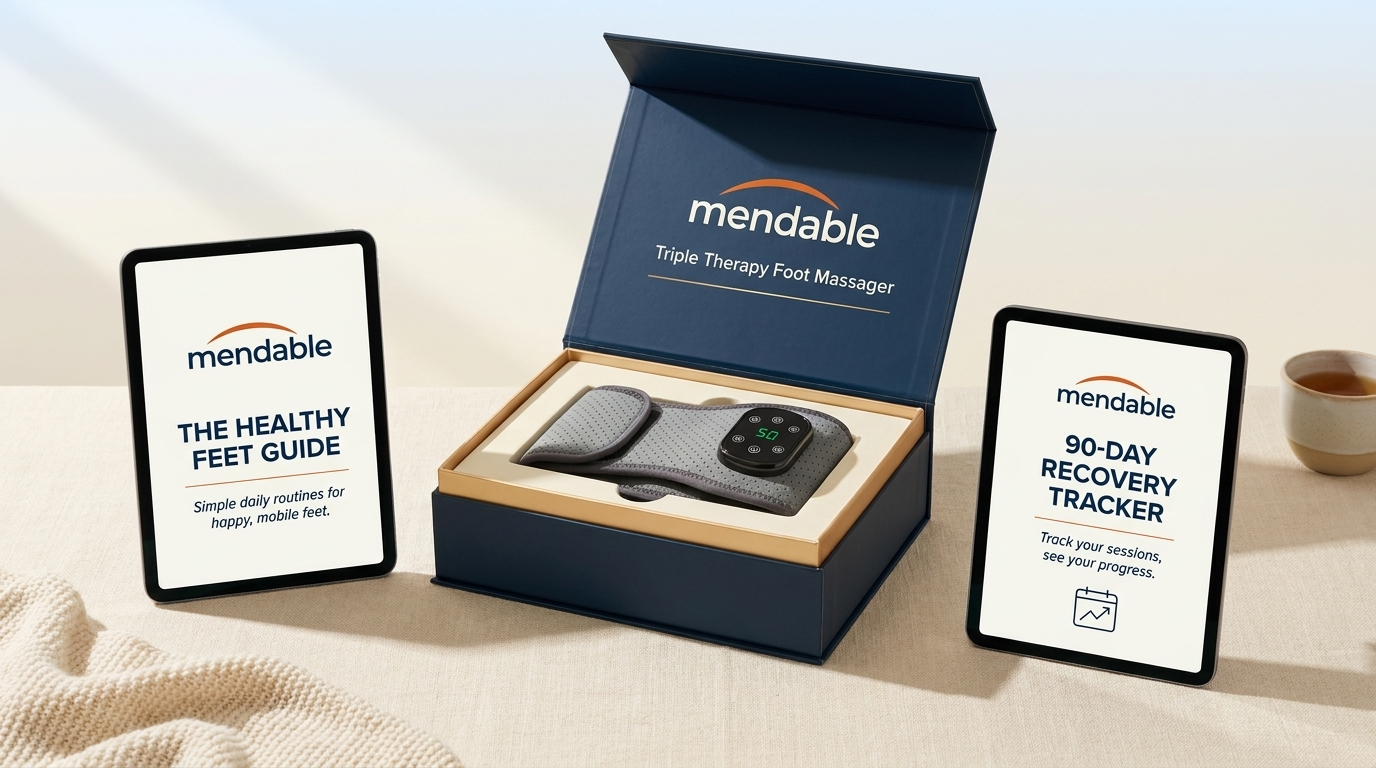
In every box: the wrap · the extension strap · the paper tape measure and 90-day tracker · a braided USB-C charging cable · the 90-Day Drainage Plan · the Swollen Legs Survival Guide.

Free shipping anywhere in Australia. Dispatched from Sydney within 24 hours.

CHOOSE YOUR PACK → 90-day money-back guarantee · 2-year replacement warranty

NINETY DAYS. FAIR GO.

Use it every evening for ninety days.

Measure on day one. Measure on day ninety.

90DAY MONEY BACK · FAIR-GO GUARANTEE

If that number has not moved — if you are not standing in your own kitchen looking down at an ankle bone you have not seen since the Howard years — then email them, send it back, and you get every cent. No forms. No store credit. No questions. Not one.

On top of that, a two-year replacement warranty on the device itself. If it fails, they replace it. That is in addition to your rights under Australian Consumer Law, not instead of them.

They are comfortable saying all that for the same reason they put a tape measure in the box.

They already know you are going to check.

TWO WAYS THIS GOES FROM HERE

SHOT 13 — ONE / TWO

One. You close this page.

Tomorrow afternoon your ankles go, as they always do, around three. You take the fluid tablet. You are up again at two in the morning. You put the pillow under your feet. You wear the shoes you don't like.

And in ten years you will be sitting in the same chair, with worse ankles, reading another page rather like this one.

Two. Fifteen minutes an evening.

In your own armchair. You measure on day one. You measure again on day thirty.

And you find out for certain — with a number, not a feeling — whether everything I have written here is true.

If it isn't, it costs you nothing whatsoever. That is the whole of the risk, and they have taken it off you on purpose.

HERE'S EXACTLY WHAT HAPPENS NEXT

  1. Choose your pack. The Pair, most likely, for the reason you now understand better than most people ever will.

  2. It leaves Sydney inside twenty-four hours. Free, anywhere in the country.

  3. When it arrives, take the tape measure out before you take anything else out of the box. Measure. Write it on the card.

  4. Sit down. Feet up. Press the button. Every evening. Thirty days. Measure again.

That is all of it. There is nothing else to do, and nothing else to buy.

Your ankles have been running your afternoons for years, and nobody ever sat down and drew you the diagram.

Somebody has now.

Fifteen minutes an evening. Ninety days to make up your mind. Nothing at stake if you decide I was wrong.

Come November, when it's thongs weather and everybody else is showing their feet, you may quite fancy showing yours.

SHOT 14 — THONGS WEATHER
GET MENDABLE FOOT RESTORE → The Pair — $138· Free AU shipping · 90-day money-back
SHOT 15 — THE DOCTOR (GATED)
Dr Michael Langford
Vascular Specialist · Sydney

P.S. — Go on. Do it now, while you're sitting down. Thumb, hard, into the inside of the ankle. Count to five. Lift. If the dent is still sitting there when you take your thumb away, you now know something that you did not know a quarter of an hour ago: the fluid is not in your blood. It is in the tissue. And nothing anyone has ever handed you across a chemist counter was pointed at it.

P.P.S. — There is a paper tape measure in the box. Nobody else in this category puts one in. You might ask yourself why not.

P.P.P.S. — Two ankles. Both of them. Every evening, together. The Pair is $138 and the single is $89, and I would rather tell you that plainly than watch you order one wrap and spend three months wondering why only one leg got better.