Your Snoring Keeps Getting Worse, Because Every Fix You've Tried Ignores Your Nose
I'm writing this because strips, tape, a mouthguard and the spare room all miss the place most snoring starts after 50: a nose that swells shut the moment you lie down. Left alone, it can end in stopped breathing, rising blood pressure and a higher stroke risk.

ENT Specialist, Brisbane · October 2026
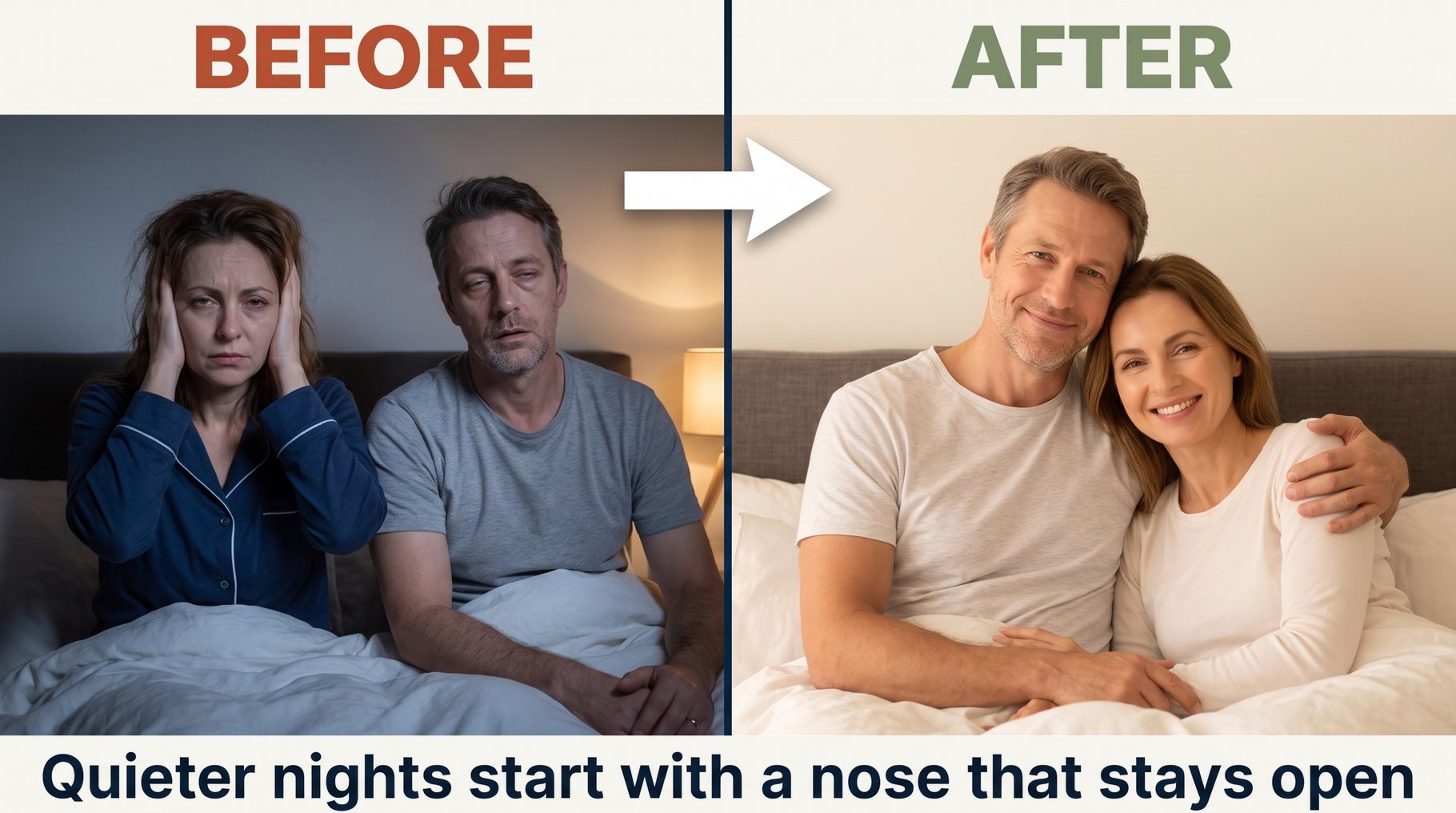
I need you to read this carefully. All of it.
Not because I'm selling you something. But because what I'm about to tell you could change the direction of your health, and the sleep of the person lying next to you. I don't say that lightly.
I've spent years looking up noses for a living. I've seen a lot of snorers walk into my rooms. And I can tell you right now: I already know your story.
You're exhausted. Not regular tired. The kind of bone-deep tired where 8 hours in bed feels like 2.
Your partner has stopped complaining about your snoring. Not because it got better, but because they gave up. Maybe they sleep in the spare room now, or on the couch. Maybe the resentment is building quietly.
You wake at 3am with a mouth as dry as sandpaper. Your nose feels fine all day, then blocks up the moment you lie down. You've tried the strips, the tape and the mouthguard, and you're still snoring the house down.
And some nights, your partner says you stopped breathing.
I know. I've heard it all. And I need you to understand something: this isn't going to get better on its own. Every night your nose shuts, it gets a little worse. And it's far more dangerous than you think.
Why I'm Asking You To Take This Very Seriously

I don't write articles like this often. But I worry about the snorers I never see.
Here's what most people don't realise:
It's not a noise problem. It's a suffocation problem.
That sound is air forced through a passage that's too narrow. In more than 1 in 10 regular snorers, it doesn't just narrow. It closes. That's sleep apnoea: your breathing stops for 10 seconds to a minute or more, and your blood oxygen drops. Up to hundreds of times a night. And most people it happens to have no idea.
→ Your heart. Every time your breathing stops, your oxygen drops and your heart takes the strain. It's linked to high blood pressure, heart attacks, heart failure and strokes.
→ Your arteries. Even habitual snoring is linked to faster ageing of the blood vessels, an early warning sign of heart disease.
→ Your brain. More than 6 in 10 heavy snorers have plaque in the neck arteries that feed the brain, and that's in snorers without serious sleep apnoea. With moderate to severe sleep apnoea, stroke risk is close to 4 times higher.
→ Your memory. The fog, the forgetting, the short fuse. That's not just age. Untreated sleep apnoea is linked to dementia.
→ Your drive home. People with sleep apnoea are about two and a half times more likely to crash. And in 2025, fatigue was behind 1 in 5 deaths on NSW roads.
→ Your bed. You end up alone in the spare room. Some partners lie awake to make sure you start breathing again.
I'm not telling you this to scare you. Too many of my patients called it 'just snoring' and waited. By the time they saw me, the damage to their heart, their memory and their marriage was already done.
Please don't be one of them.
What Happens If You Keep Ignoring This
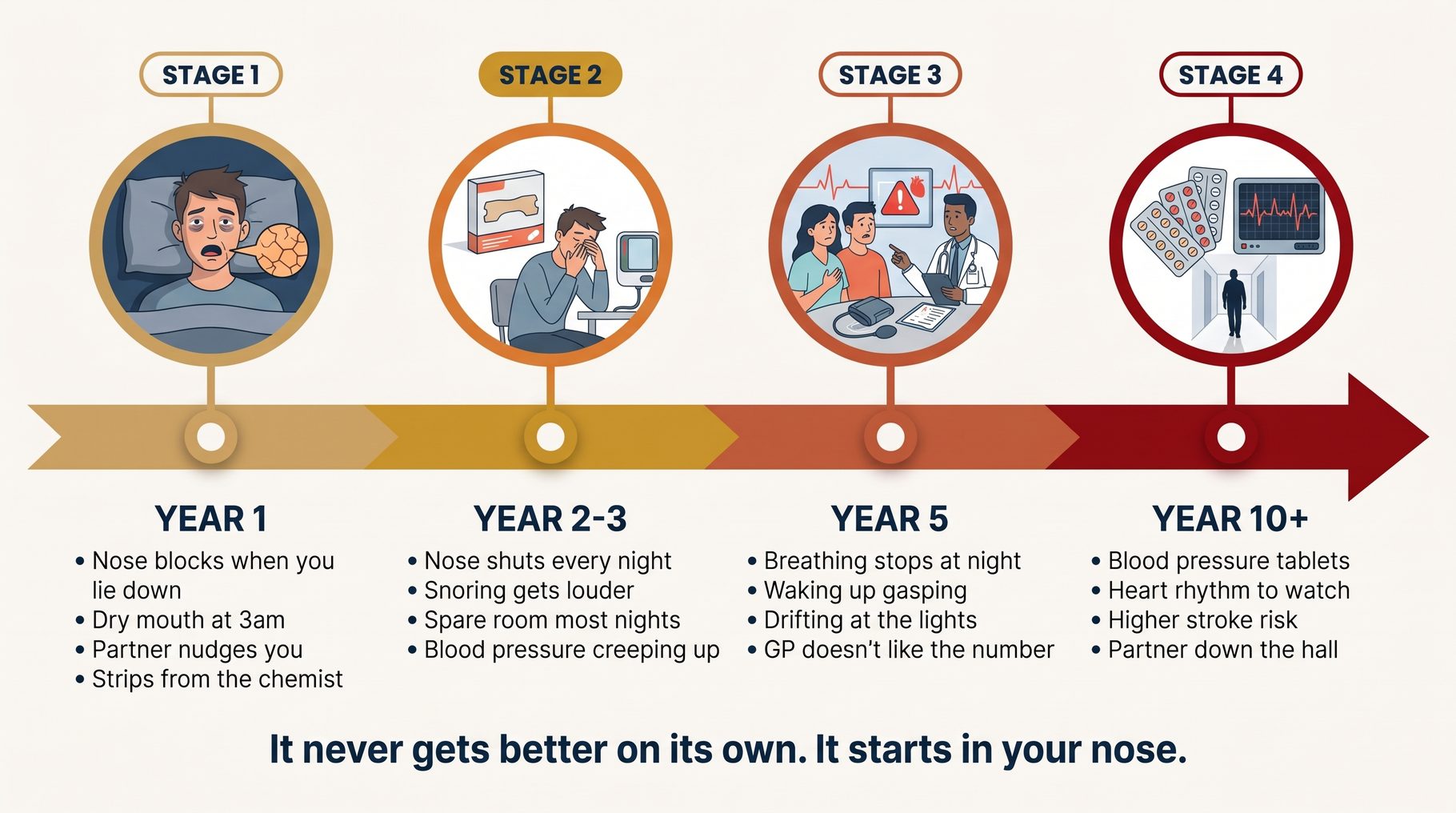
I nearly left this part out. It's uncomfortable. But too many patients have sat across from me and said 'I wish someone had told me sooner.' So I'm telling you now. This is the pattern I see in my rooms, over and over:
→ Year 1: The "It's Just Snoring" Phase
Your nose feels a bit blocked when you lie down, worse in hay fever season and every time you catch a cold. You don't notice your mouth falling open, but you wake with it dry. Your partner gives you a nudge. You grab some strips from the chemist. A little quieter. Still snoring. Meanwhile your sleep is breaking up every night, and you never wake enough to notice. You blame work, stress, age.
→ Year 2-3: The Nose Shuts Every Night
It's not just hay fever season any more. It's every night, about ten minutes after your head hits the pillow. You try a decongestant spray, but use it for more than a few days and your nose blocks up worse when you stop. Every night your nose shuts, it sucks the walls of your throat closer together, and the snoring gets louder. Your partner moves to the spare room 'just for tonight'. Then most nights. At your check-ups, your blood pressure has started creeping up.
→ Year 5: The Breathing Stops
Your partner tells you something that frightens you both: you stopped breathing. You wake at 3am gasping, heart pounding. Eight hours in bed and you're wrecked by lunch. You catch yourself drifting at the lights on the way home. Your GP takes your blood pressure and doesn't like the number. This is when most people finally come and see me. Five years in. Five years of damage that didn't need to happen.
→ Year 10+: The Years You Don't Get Back
Blood pressure tablets. A heart rhythm that needs watching. A stroke risk you never thought was yours. A memory that isn't what it was. And a partner who has slept down the hall for so long it's just how you live now. I have patients at this stage. Good people who never knew their snoring started in their nose.
You're at Year 1 right now. Maybe Year 2. If your nose shuts when you lie down and you wake with a dry mouth, you're at the start of this, not the end. You still have time.
Please don't waste it.
A quick word before you read on. Australia's free health advice service, Healthdirect, says that if your blocked nose is worse at night, your doctor might need to consider sleep apnoea. So if your partner has ever seen you stop breathing, if you wake up gasping, or if you're nodding off during the day, book in with your GP this week and ask about a sleep study. With a GP referral, Medicare can cover the study if you're eligible, and some home studies are bulk billed. Nothing in this article replaces that appointment.
So What's Actually Causing This?
Here's what I explain to every patient on their first visit:
Your snoring doesn't start in your throat. That's just where the sound comes from. It doesn't start in your jaw either.
It starts in your nose.

About ten minutes after your head hits the pillow, the tissue inside your nose, already a bit inflamed, swells even more. Your nose quietly shuts, your mouth falls open, and you breathe through your mouth all night.
That creates a vacuum inside your throat that pulls its walls closer together.
Narrow throat = snoring.
Closed throat = sleep apnoea.
That's it. That's the whole mechanism.
Australia's Sleep Health Foundation puts it in one line: a blocked nose causes mouth breathing, which can lead to snoring and sleep apnoea.
It's not a noise problem. It's a nose problem.
Why Nose Strips, Mouth Tape And Mouthguards All Fell Short
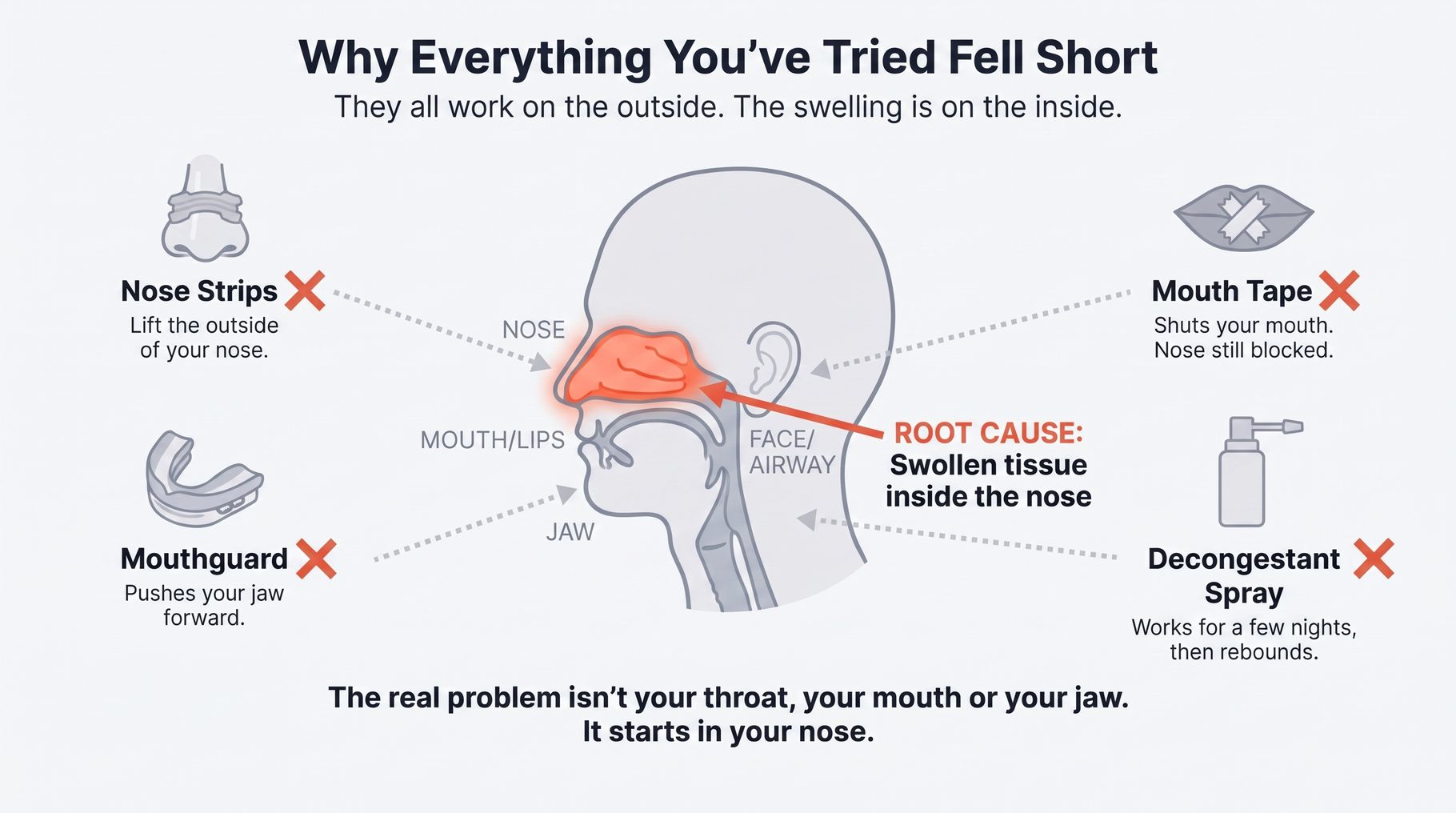
And that's exactly why nothing you've tried has worked.
Nose strips lift the outside of your nose. They help a bit, but the swelling is on the inside. And at AU$30.99 a box of 30, you're paying for that every month.
Mouth tape keeps your mouth shut, but your nose is still blocked. That can add up to around AU$600 a year, and you still wake up stuffy.
Mouthguards push your jaw forward. Some people do well with them, but plenty find them hard, uncomfortable and sore on the jaw. A dentist-fitted splint can cost AU$1,595 to AU$2,190.
Decongestant sprays open you up for a few nights, then your nose blocks up worse when you stop.
Every single one of these works on the outside of your nose, your mouth or your jaw. None of them calms the swollen tissue inside your nose, which is where your snoring actually starts.
Already diagnosed and using CPAP or a splint? Keep using it. It's doing a job nothing in this article replaces, and this isn't a sleep apnoea treatment. But a stuffy nose is a known problem on CPAP. If yours shuts at night, ask your sleep doctor whether a few minutes of Pre-Pillow Light can sit alongside it.
Until now.
The Breakthrough I Wish I'd Found Years Ago
I'll be honest with you. When I first heard about putting light up your nose before bed, I was sceptical. Another gadget? Another promise?
Then I looked at what red and blue light actually do to swollen, irritated tissue. Then I suggested it to a few patients who'd tried everything else. Then I listened to what their partners said.
It's the only thing I've found that works where most snoring actually starts: inside the nose, before you lie down.
Here's how it works:
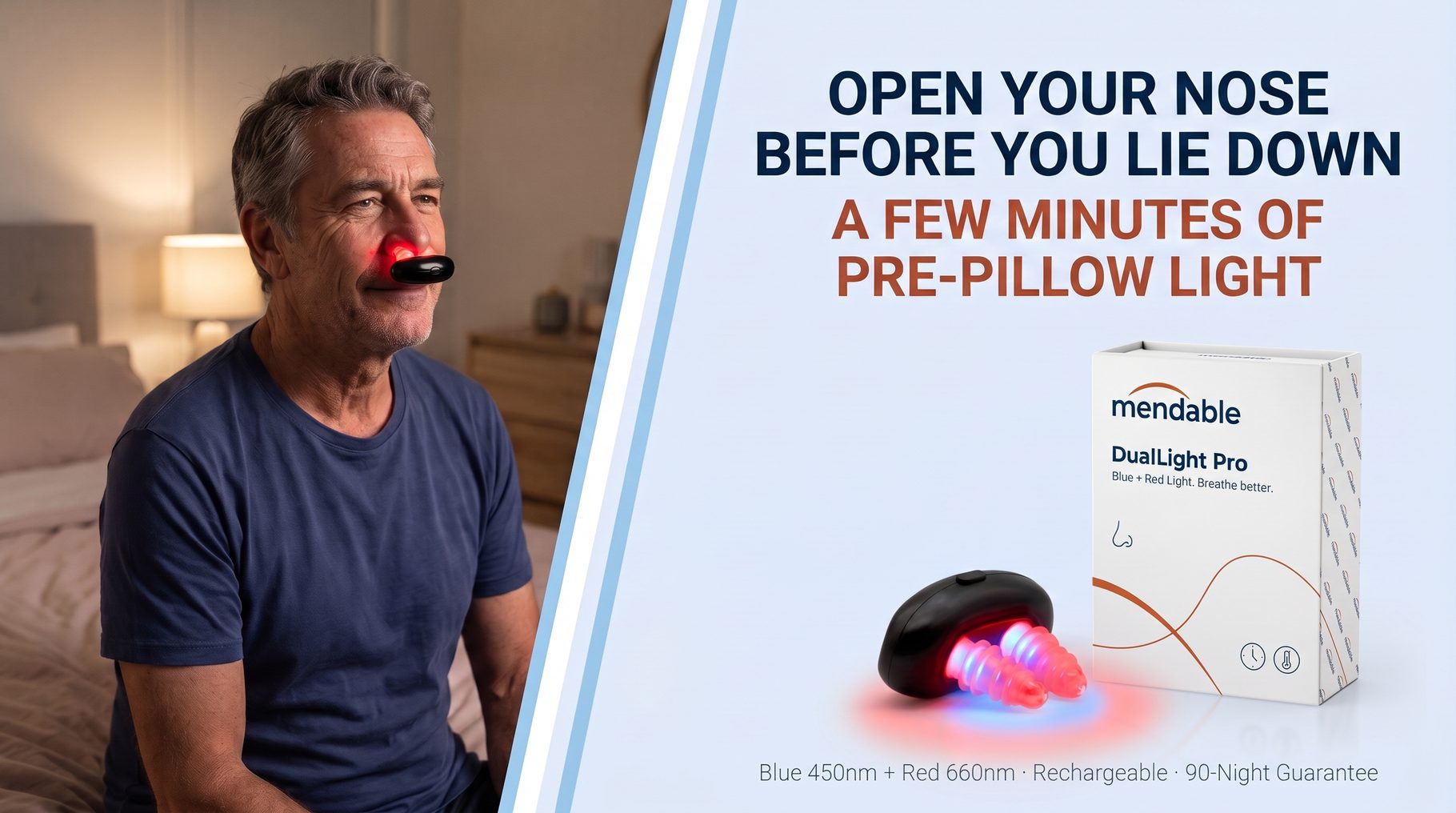
The DualLight Pro is a small, rechargeable device with a soft tip that sits just inside your nose for a few minutes before bed. I call it Pre-Pillow Light.
Red light at 660nm calms the swollen tissue. Blue light at 450nm works on what keeps it inflamed. Your nose reaches the pillow open, and stays open.
If your nose shuts when you lie down, open it before you lie down.
No mask. No hose. No tape. No mouthguard. Nothing to wear while you sleep.
A few minutes. Then you go to sleep.
But here's what makes it truly different:
Strips pull on the outside of your nose. The swelling is on the inside. This is the first thing I've seen that works on the inside.
I'll Be Direct With You
After years of looking up noses, I've watched people go through the same cycle:
Ignore the snoring → buy strips from the chemist → still snoring → try the tape → wake up stuffy → buy a mouthguard → sore jaw → try a spray → rebound → move to the spare room → accept being exhausted forever.
Meanwhile their blood pressure climbs, their partner sleeps down the hall, they nod off on the drive home, and their nose shuts again every single night.
I'm tired of watching it happen.
The DualLight Pro is the only thing I've come across that breaks this cycle, because it's the only one that works where it starts: inside your nose.
It's drug-free. It's comfortable. It takes a few minutes before bed. And there's nothing to wear while you sleep.
I can't force you to take action. But as a doctor who has seen what happens when people wait, when they tell themselves "it's just snoring" for one more year, two more years, five more years, I am asking you:
Don't wait.
Your heart can't wait. Your brain can't wait. Your partner can't wait. And your nose shuts again tonight.
If you recognise yourself in anything I've written today, please take the next step. Not tomorrow. Tonight.
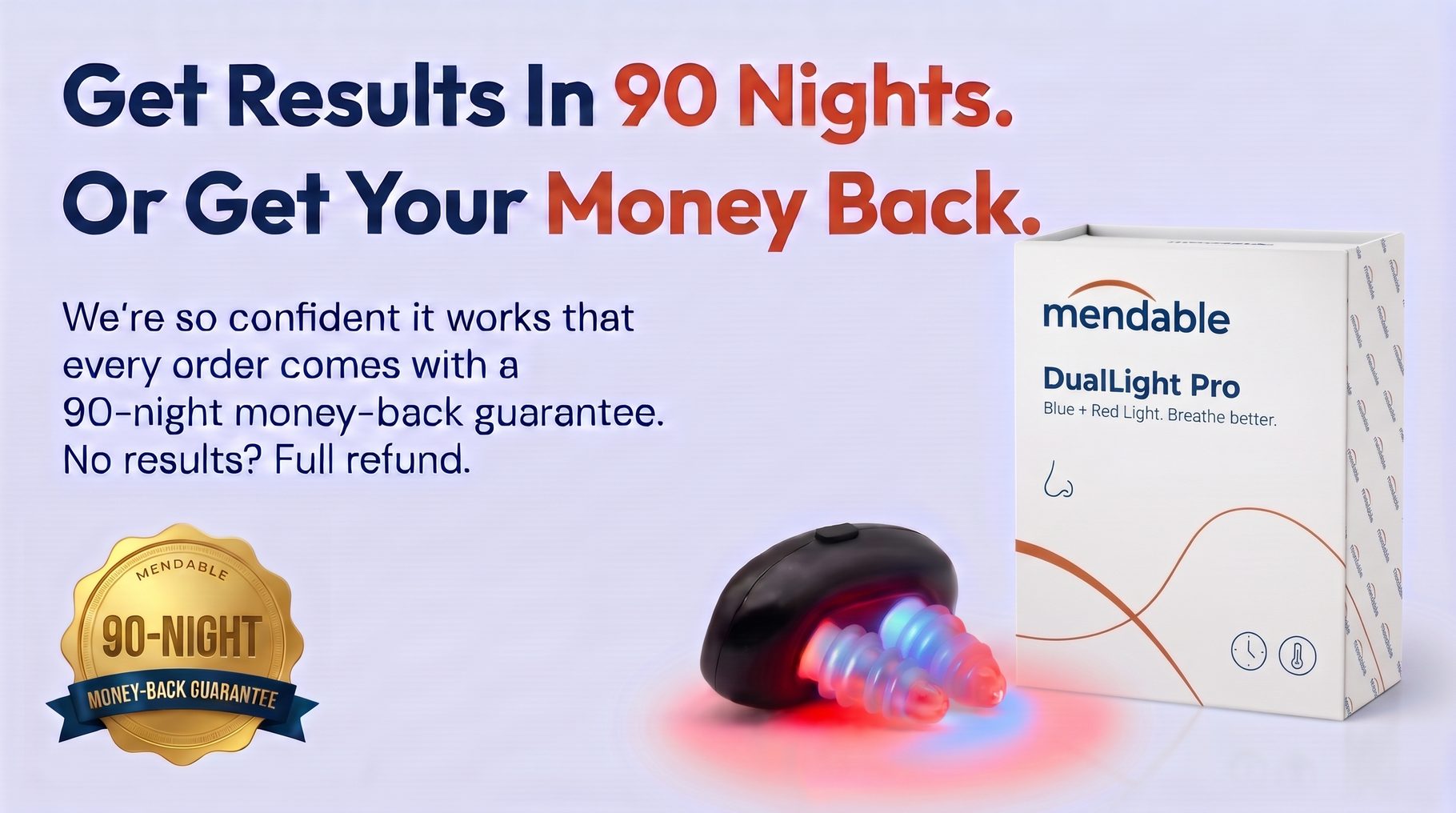
It comes with a 90-day money-back guarantee, so you risk absolutely nothing.
You Risk Absolutely Nothing. I Made Sure Of That.
Before I suggest anything to my patients, I need to know they're protected. That's non-negotiable for me.
That's why I asked Mendable about their guarantee before I wrote a single word. Their answer is why I'm comfortable putting my name on this.
You have 90 full nights to try it.
Not 30. Not 60. Ninety, because a nose is best judged night by night, and your partner deserves a fair say.
If after 90 nights your snoring hasn't eased… if your partner isn't sleeping better… if you don't wake up feeling like a different person…
You send it back. Full refund, even if you've used it. No questions. No hoops. That's in addition to your rights under Australian Consumer Law.
They do it because it works, and they know it.
So let me be clear: the only risk here is doing nothing.
Try The DualLight Pro Risk-Free For 90 NightsA Personal Note: About The Person Sleeping Next To You

I want to talk to you about something that doesn't get discussed enough in medical articles.
Your partner.
In my rooms, I don't just see the snorer. I see the couple. Because snoring is never a solo problem. It takes two people's sleep, two people's health and two people's patience.
Some of the wives I see haven't had a full night in years. They've set up another bed, or they can hear him from the other end of the house. They lie there listening, waiting for the next breath.
And some of the husbands tell me they feel ashamed of a noise they can't control, watching the marriage wear thin one bad night at a time.
Here's what I want you to understand:
Fixing your snoring isn't just about you. It's about the person who lies awake next to you every night. The person who moved to the spare room not because they don't love you, but because they can't keep going on three hours of broken sleep.
When my patients finally get their nose open at night, the first thing most of them tell me isn't "I sleep better."
It's "She's back in our bed."
It's "He finally looks rested in the morning."
It's "We're a couple again."
If you won't do this for yourself, do it for them. They've waited long enough.
How Does It Actually Work? (It Takes A Few Minutes)
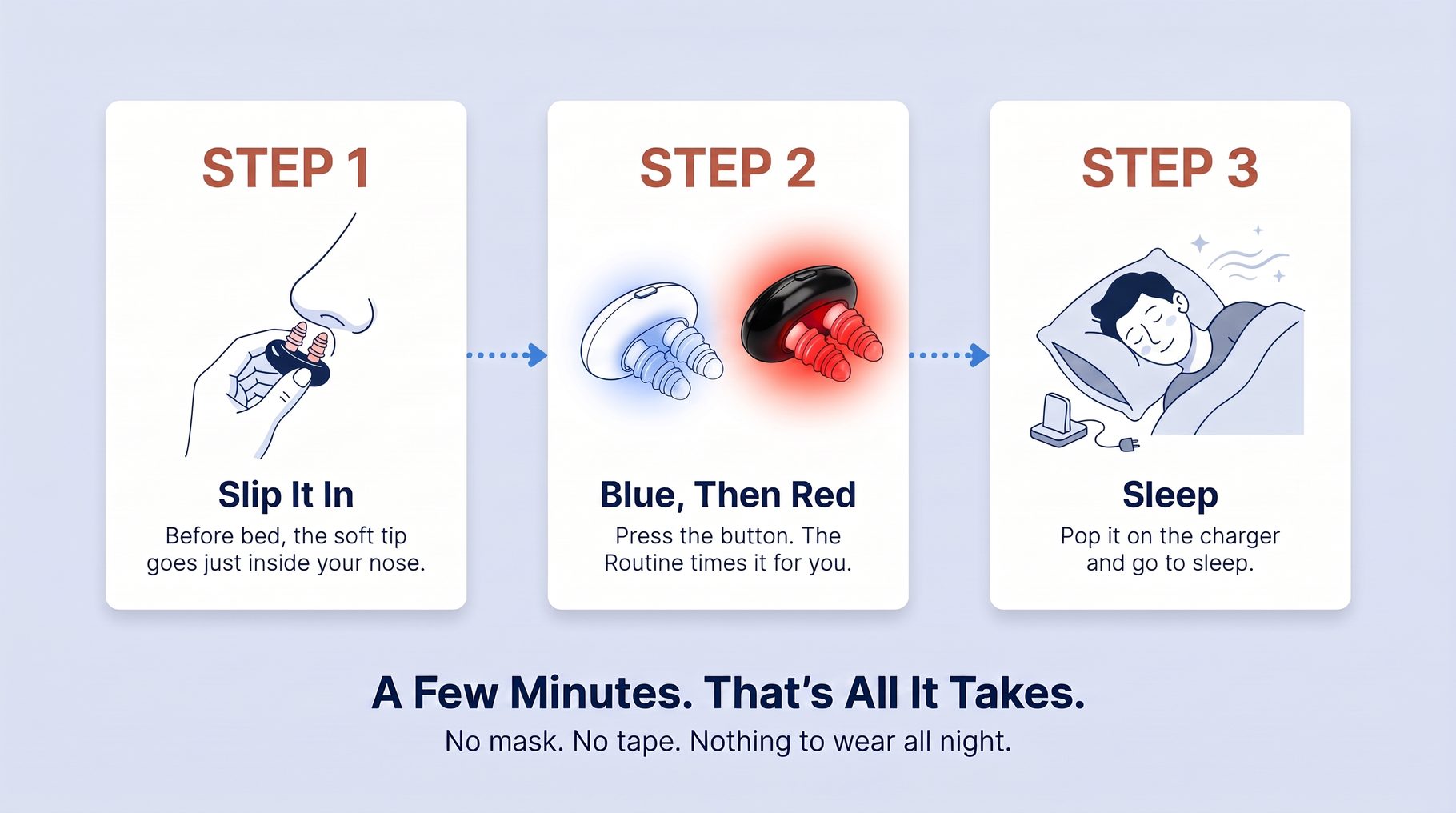
One thing my patients love about the DualLight Pro is how simple it is. No setup. No fitting appointment. No learning curve.
Step 1: Before bed, slip the soft tip just inside your nose.
Step 2: Press the button. Blue light first, then red. The free DualLight Routine on your phone times it for you.
Step 3: A few minutes later, pop it back on the charger and go to sleep.
That's it.
Do it while your partner brushes their teeth. There's nothing on your face, nothing in your mouth and nothing to wear all night.
And because it works before your head hits the pillow, your nose gets to the pillow open, instead of shutting ten minutes later.
What To Expect In Your First 14 Nights

My patients always ask me: "How fast will it work?" Here's what I tell them.
→ Nights 1-3: Your Partner Notices First
The snoring is often quieter from the first few nights. You might not feel very different yet, but the person next to you may sleep through for the first time in months.
→ Nights 4-7: Mornings Change
You wake up with your mouth closed and less dry. Your nose feels clearer when you get up. The heavy, foggy start to the day eases.
→ Week 2: Back In The Same Bed
Your partner stops reaching for the earplugs. The spare room goes back to being the spare room.
→ After That: Keep It Going
Like brushing your teeth, it works best as a nightly habit. A few minutes before bed, every night.
Give it 14 nights and let your partner be the judge. The free DualLight Routine even has a 14-Night Partner Check, so they can score it.
Questions My Patients Ask Me Every Day
Does it hurt? Will I feel it?
No. The soft tip sits just inside your nose and the light is gentle. There's no heat, no spray and nothing to swallow. Most people say they barely feel a thing.
I've been diagnosed with sleep apnoea. Will this help?
Keep using your CPAP or splint. It's doing a job nothing in this article replaces, and this isn't a sleep apnoea treatment. But a stuffy nose is a known problem on CPAP. If yours shuts at night, ask your sleep doctor whether a few minutes of Pre-Pillow Light can sit alongside it. And if you've never been checked but your partner has seen you stop breathing, see your GP first.
What if my snoring isn't coming from my nose?
Ask yourself two things. Does your nose feel fine during the day but block up when you lie down? Do you wake up with a dry mouth? If the answer is yes, your nose is very likely part of the problem. The free DualLight Routine includes a short "Is It Your Nose?" check. And if it doesn't help, you have 90 nights to send it back.
I have hay fever or a deviated septum. Will it still work?
If your nose swells at night from hay fever, dust or a cold, that swelling is exactly what the light works on. A badly deviated septum is a structural problem that light can't move, so if you've been told yours is severe, talk to your GP or ENT first.
I use a nasal spray every night. Can I use both?
Yes. Plenty of people use it alongside what they already have. Some find they reach for the spray less often.
Why hasn't my GP mentioned this?
Light for the inside of the nose isn't part of the standard snoring advice yet. Most snoring conversations at the GP are about weight, alcohol and sleeping position, and the nose gets missed. That's exactly why I'm writing this article.
What if it doesn't work for me?
Then you send it back within 90 nights for a full refund, in addition to your rights under Australian Consumer Law. I wouldn't suggest anything that didn't offer that level of protection.
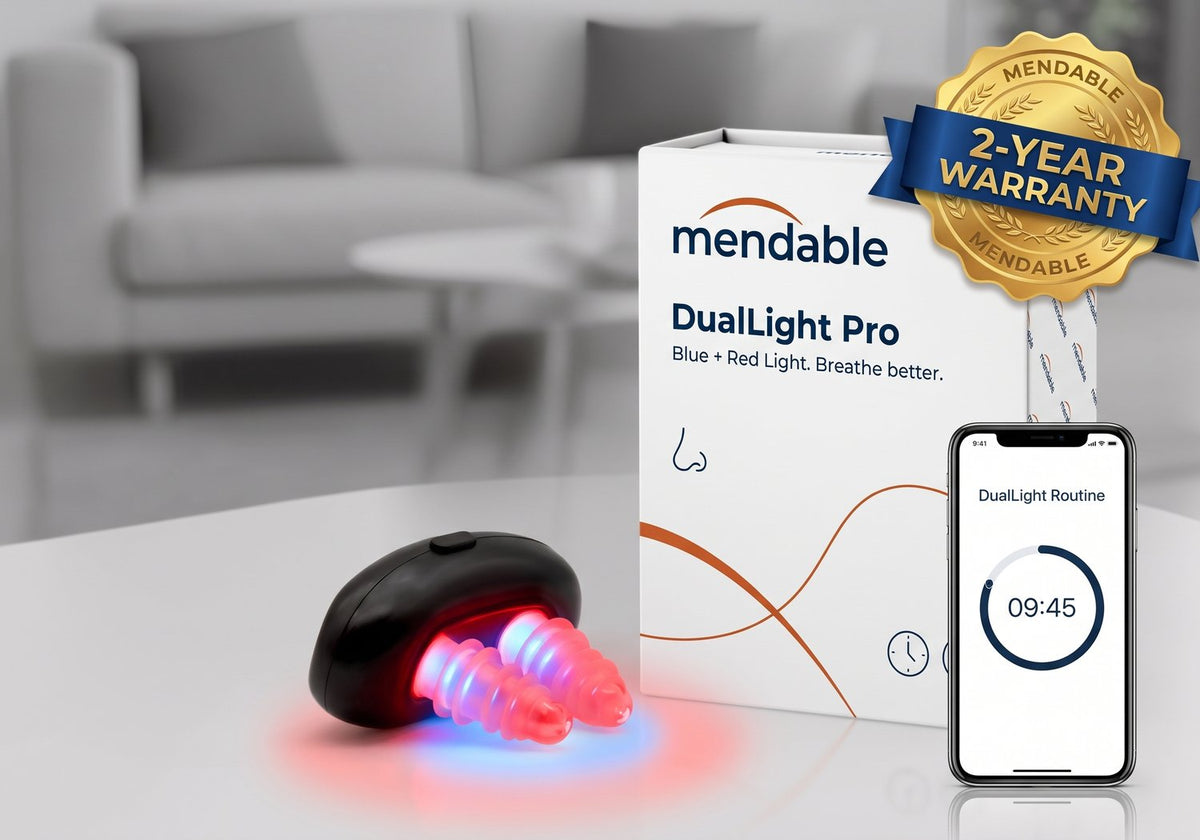
Early Black Friday: A$172 of FREE gifts with every order
Act Now and You'll Get:
- DualLight Pro Complete Kit (device, charging cable, premium box)
- FREE DualLight Routine (A$49 value)
- FREE eBook: The 30-Day Clear Breathing Plan (A$29 value)
- FREE DualLight Travel Case (A$29 value)
- FREE Spare Soft Tips Set (A$20 value)
- FREE 2-Year Warranty (A$45 value)
- Free shipping Australia-wide
AU$119. Once. About 33 cents a night for your first year.
Our Early Black Friday gifts end 27 November.
NOTE: Not available on Amazon or in chemists.
About the author: Dr. Fiona Hartley is an ear, nose and throat specialist in Brisbane. Most of the people she sees have tried the sprays, the strips and the tablets, and still can't breathe through their nose at night.