 Trending in 'Health'
Finally! Real Relief From Chronic Shoulder Pain

Customer Reviews
14,000+ customer ratings
By Feature
Sydney Orthopaedic Surgeon: "This Is What I Now Ask Patients to Try Before Shoulder Surgery"
After 2,500 rotator cuff operations, he admits: "Most of my patients shouldn't have been on my table." Here's the blood-flow problem behind most shoulder pain after 45 — and the 12-minute at-home routine now keeping his patients off the operating table (without tablets, injections or more $95 physio).

I've spent 22 years operating on shoulders. Over 2,500 rotator cuffs.
And after all that, I've come to believe something most of my colleagues won't say out loud.
Most of the patients on my table didn't need to be there.
I'm not against surgery. When a shoulder genuinely needs repairing, nothing else will do. But for the chronic, aching, won't-go-away pain that turns up after 45 — the kind you've probably been living with for a year or two — surgery is the last option, not the first.
Because in most of those cases, the problem was never a tear that needed cutting.
It was a blood-flow problem.
And here's the part that surprises people: no one has likely ever mentioned it to you. Not your GP. Not your physio. Not the doctor who gave you the cortisone.
Once you understand it, the reason nothing you've tried has worked finally makes sense. The heat packs. The Voltaren. The $95 physio sessions that loosened it for a day. The cortisone that was brilliant for six weeks, then wasn't.
None of them failed because they were done badly. They failed because none of them feeds the tissue.
There is a way to feed it. It takes 12 minutes a day, you do it in your own lounge room, and it's the first thing I now ask my patients to try before we ever talk about an operation.
Let me walk you through it.
The 30-Second Shoulder Check
Before I explain anything else, try this. It takes half a minute, and it'll tell you how far along your shoulder actually is.
This isn't a diagnosis. It won't tell you if you have a tear. It tells you something more useful: how long your shoulder has been running short on blood.
Stand up. Give yourself a bit of room.
Reach your sore arm straight up overhead, as far as it comfortably goes. Stop if it bites.
Reach behind your back, like you're doing up an apron or reaching for your back pocket.
Think about last night. Could you lie on that shoulder, or did it wake you?
Now — where are you?
You can get there, but it aches or pulls.
Your shoulder is in the early stage. The blood supply is dropping, but the tissue can still respond quickly once you feed it.
You can't quite get there, and you've quietly stopped trying.
The starvation has been running longer. This is where most of my patients sit when they walk in.
Sharp pain, no chance of getting there, and it wakes you at 4am.
The tissue has been starved a long time. It still isn't a tear that needs cutting — but it needs feeding now, not later.
Wherever you landed, hold that thought. It'll make sense in a minute.
The Patient Who Changed How I Practise
Last winter, a woman named Margaret sat across from me.
Sixty-two. A retired primary school teacher from Newcastle. Before she got to me, she'd seen three GPs, two physios, and had one cortisone shot.
She looked me dead in the eye and said: "I just want it fixed. I'll book in for the surgery today if that's what it takes."
I've heard that sentence hundreds of times. Same chair. Same exhaustion.
She couldn't wash her own hair. Putting on a shirt was a five-minute negotiation. She'd stopped picking up her grandkids because she braced for it.
And she was stuck in the worst spot of all — too sore to live normally, but not so far gone that she wanted to hand over four to six months of her life to a repair and the rehab that follows.
I told Margaret what I tell most people in that chair.
Surgery for this kind of shoulder pain is the last option, not the first.
And in her case — like in most cases — the tear on the scan wasn't the thing causing her pain.
Her shoulder was starving. Let me explain exactly what I mean.
What I'd Been Missing for 20 Years
For years, patients like Margaret bothered me.
I'd send them for physio. Cortisone. Rest. They'd come back a few months later, no better, and I'd book the surgery — because that was the next box to tick.
But a pattern kept nagging at me. These weren't torn-in-an-accident shoulders. These were slow, quiet, won't-heal shoulders. And the usual explanations — "it's just wear and tear," "it's your age" — never sat right.
So I went back to the research. Not the surgical papers. The ones about blood supply.
And what I found is something every surgeon learns in training and then mostly forgets.
The rotator cuff is one of the worst-supplied tissues in the entire body. It sits at the very edge of its own blood supply — even in a fit 25-year-old.
It isn't your muscles. It isn't your posture. It isn't even inflammation, really.
Your shoulder hasn't worn out. It's been quietly starving for years.
Let me show you how that happens.
The Hidden Reason Your Shoulder Won't Heal
Think of the blood supply to your rotator cuff like a garden hose running to the far corner of the yard.
When you're young, water reaches the corner fine. The grass stays green.
But that corner was always the last to get water. And after 40, the hose starts to narrow.
By 50, blood flow to the rotator cuff has usually dropped by 30 to 50 percent. By 60, it can be down by 70.
The tissue is still there. The structure is still there. But the supply line that keeps it repairing itself — the oxygen, the nutrients, the machinery that clears inflammation and rebuilds worn fibres — has dried up.
Doctors have a name for this. Hypovascular degeneration. In plain English: the tissue is starving.
Here's why that matters day to day.
Every one of us microscopically tears the rotator cuff dozens of times a day, just reaching and lifting. At 30, the blood shows up and repairs it within hours. Job done.
The same tiny tear at 60? The blood doesn't show up. The repair doesn't happen. The damage stacks up. The inflammation lingers, because there's no flow to flush it out.
A healthy shoulder slowly becomes a stiff, tender, painful one. Not from one injury. From years of quiet starvation.
Now the failures make sense.
Voltaren and Panadol Osteo mask the pain signal. They don't restore blood flow, so the pain returns the moment they wear off.
Cortisone calms the inflammation — which feels like a miracle for about six weeks. But it weakens tendon tissue over time, and it does nothing about why the inflammation was there.
Physio strengthens the muscles around the shoulder. That's genuinely useful. But no exercise can rebuild the capillaries you've lost.
Heat packs warm the skin and the top layer of muscle. The rotator cuff sits far deeper. A heat pack feels lovely and reaches almost none of the tissue that needs help.
And surgery repairs the tear — but doesn't touch the reason the tissue broke down in the first place.
None of them is feeding the tissue. That's the whole problem.
What Actually Feeds a Starving Shoulder
If the problem is starvation, the answer isn't to stitch the tear. It's to get blood flowing back into the tissue so it can do what it's built to do — repair itself.
There are three ways to drive deep, lasting blood flow back into a starved rotator cuff at home.
Precision heat at 42°C. Not a hot water bottle. Steady, controlled heat at the top of the safe range — warm enough to reach past the skin into the muscle and tendon. This opens the capillaries that have been shut for years. The vessels widen. Oxygen and nutrients get in.
Rhythmic compression. When tissue is squeezed and released in a rhythm, two things happen. The inflammatory waste sitting in the joint — the stuff behind that dull, constant ache — gets pushed out. And fresh, oxygen-rich blood is drawn in to replace it. It's what a good remedial masseur does with their hands, except steady for the whole session, every time.
Targeted vibration at 60Hz. At the right frequency, vibration reaches deeper than heat alone. It loosens the calcified tissue that builds up over years of guarding the joint, breaks down the adhesions that lock a shoulder stiff, and wakes up the nerve signals that tell the body to start repairing.
Each of these is standard in any sports medicine clinic in the country. Heat therapy. Compression therapy. Therapeutic vibration. Nothing exotic.
But here's what we'd all been missing.
They only work if you do all three. At once. In the same session.
Heat on its own opens the vessels but doesn't flush the waste or break the adhesions. Compression on its own moves fluid but can't open vessels that have been shut for years. Vibration on its own reaches deep, but the tissue isn't ready to use it if there's no blood getting there.
Run all three together, for 12 minutes a day, and the shoulder finally gets what it's been starved of for a decade.
We called it Triple Therapy.
42°C
Precision heat
Opens the capillaries that have been shut for years. The vessels widen. Oxygen and nutrients get in.
Rhythmic
Compression
Pushes inflammatory waste out of the joint and draws fresh, oxygen-rich blood in to replace it.
60Hz
Targeted vibration
Loosens calcified tissue, breaks down adhesions and wakes the nerve signals that start repair.
Each therapy is standard in any sports medicine clinic. Running them in the same session is the part that isn't.
It Kept Happening
I started with the patients I believed had no business being rushed into an operation. People like Margaret.
The instruction was simple: all three therapies, together, 12 minutes a day, at home.
Then I waited to see if it was a fluke.
It wasn't.
Of the chronic-pain patients I've done this with — people who walked in expecting me to book their surgery — most have not gone on to have one.
I'll be straight with you, because you've probably heard enough big promises already. Some patients still will need surgery. Some shoulders are genuinely too far gone, and this won't change that. I tell those people the truth.
But for the rest — the Australians in their 50s, 60s and 70s whose shoulders simply needed feeding again — it's done what physio and cortisone never could.
It restored the tissue.
And once I'd seen it happen enough times, I had a problem of my own.
I couldn't send every one of these patients home with a clinic full of equipment. The only people this could help were the handful who found their way to my rooms.
So I made a decision. I'd turn the whole thing into one simple device an Australian could use at home — no appointments, no specialist, one button.
What we built surprised even me.
So I Built It
About 18 months ago, I sat down with a small team of biomedical engineers.
The brief was short.
One device. All three therapies — heat, compression, vibration — at the same time, in one session. Built for a 65-year-old to use alone in her lounge room without reading a manual.
It had to do four things, or it wasn't worth making:
Feed the tissue, not mask the pain. Restore blood flow to the rotator cuff itself — the deep tissue a heat pack never reaches.
Work in 12 minutes a day. Not weeks of appointments. Something you can do while the news is on.
Cost less than a single block of physio. If the price put it out of reach for a pensioner in Newcastle, it failed.
Need one button. Strap it on, press start, it runs, it shuts itself off.
It took a year of prototypes to get the heat steady at 42°C, the compression cycling in rhythm, and the vibration sitting at 60Hz — all in one wrap that fits either shoulder.
What we ended up with is the device I now recommend before surgery.
Introducing Mendable Shoulder
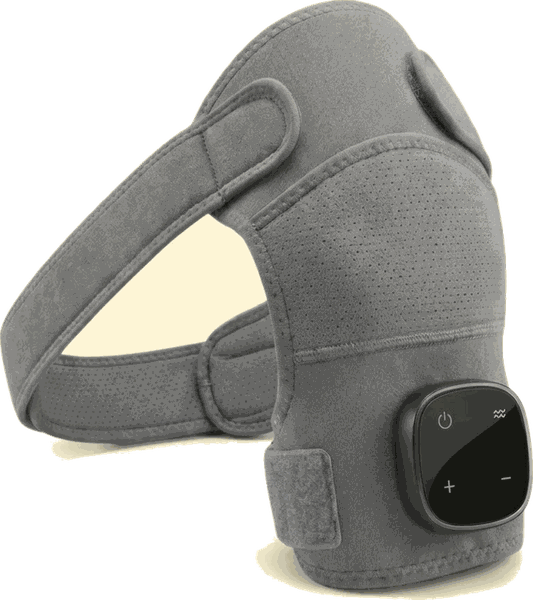
It's a wrap that straps onto your shoulder. One control unit. One button.
It runs all three therapies at once — 42°C precision heat, rhythmic compression, 60Hz targeted vibration — for exactly 12 minutes, then shuts off.
You do it once a day. In your own lounge room. While you watch the news or have a cup of tea.
Here's what a session actually looks like.
Strap it on.
Place the wrap over the sore shoulder and fasten the strap under your chest. Twenty seconds. It fits left or right, and there's an extension strap in the box for larger frames.
Press start.
The heat comes up first. Most people feel deep warmth reaching into the shoulder within about 90 seconds — not the surface warmth of a wheat pack, but warmth that gets in under it.
Then all three work together.
The heat holds at 42°C and opens the capillaries. The compression squeezes and releases in a steady rhythm, pushing stale inflammatory waste out and drawing fresh blood in. The vibration sits at 60Hz and works on the calcified, stuck tissue that's been locking the joint.
At 12 minutes, it stops.
You take it off and get on with your day. Most patients describe the shoulder as feeling "loosened" by the end of the first session. That's not the repair — that's the blood arriving. The repair comes with the days that follow.
It's cordless, charges by USB-C, and a full charge gives you roughly a week of daily sessions. There are three heat levels and three vibration modes, so you can ease in gently on the first few days and build from there.
No app. No setup. No appointments.
What Changes, and When
I'll give you the pattern I see, because "it works" means nothing without a timeline.
- Session 1
Deep warmth within 90 seconds. The shoulder feels loosened by the end.
- Days 7 to 14
The 4am stabbing wake-ups start to fade. Morning stiffness shortens. Reaching overhead starts to come back. 95% of people feel real change in this window.
- Weeks 4 to 6
This is where the tissue is genuinely repairing. People start reaching for things they'd stopped reaching for. Sleeping on the bad side comes back.
- Day 90
Most describe the shoulder as "years younger." The chronic pain that ran their life for two years is no longer the centre of their day.
★★★★★ Mendable Shoulder now has a 4.8-star rating from more than 14,000 Australians. Here's what a few of them said.
I was three months out from a rotator cuff repair. My daughter ordered me Mendable Shoulder. Six weeks in, I rolled over in bed without waking up. I rang the surgeon's rooms and told them I'd see how I went. Haven't called back. The shoulder is mine again.
23 years on the tools. Workers' comp was already talking light duties for good. Three weeks with Mendable I was back framing. My GP told me it was 'unlikely' I'd recover without surgery. I'm 58 and back on the job. Wish I'd ordered it 18 months ago.
Spent thousands on cortisone that worked for three weeks at a time and then stopped. Mendable has done more for me in six weeks than three years of injections. Ordering one for my mum next.
I was sceptical — years of physio and cortisone made an at-home gadget sound too easy. After a fortnight the constant ache stopped being constant. By six weeks I was reaching across to the passenger seat again without thinking about it. First thing that's properly worked.
Notice what Brad said. A fortnight before the ache changed. Six weeks before the reach came back. That's normal. The tissue has been starving for years — it doesn't refill in three days.
Why I Tell Patients Not to Wait
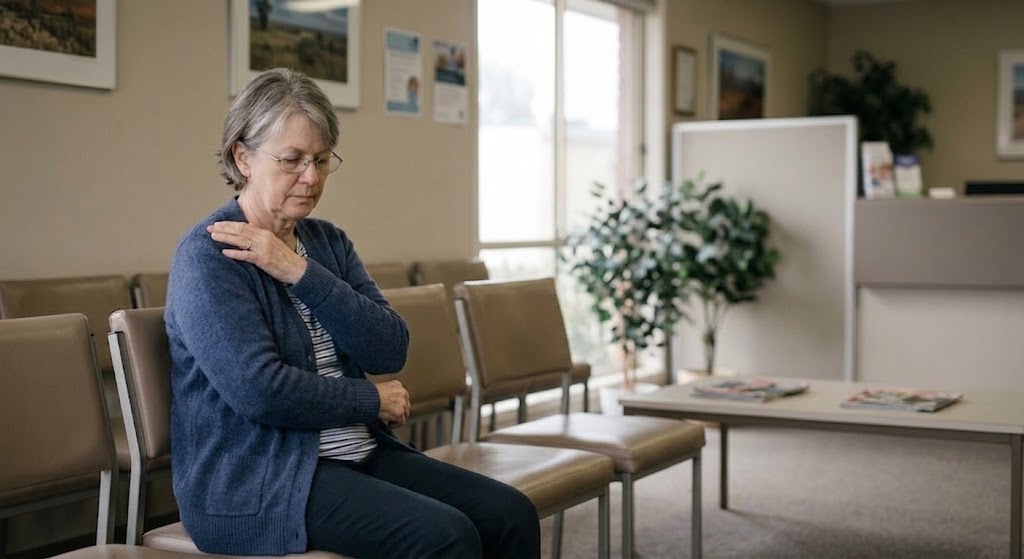
I want to be careful here, because you've heard enough scare stories.
I can't put a number on a screen and tell you your shoulder has a deadline. Medicine doesn't work like that.
But I can tell you three things I know to be true.
The blood supply keeps dropping. It doesn't plateau. By 50 it's typically down 30 to 50 percent. By 60, up to 70. Every year the tissue starves a little more, and every year there's a little less of it to repair.
Every round of cortisone weakens the tendon. It buys six good weeks and quietly costs you tendon strength. Do it three or four times and the tissue you eventually want to repair is thinner than when you started.
The stiffness calcifies. A shoulder you stop moving because it hurts builds up calcified tissue and adhesions. That's what locks it. The longer it's locked, the more there is to loosen.
None of that means it's too late for you. Most of the patients I've put on this had been in pain for two years or more, and their tissue still responded.
It means the shoulder you have today is the best one you're going to get to work with.
When Margaret came back after six weeks, she didn't say anything at first. Then she lifted her arm above her head — slowly, but all the way — and looked at me.
"I haven't done that in two years. I didn't book the surgery."
She hasn't booked it since.
Most of my patients tell me the same thing afterwards. Not "thank you." It's: "I wish I'd known about this 18 months ago."
Think back to the 30-second check at the top of this page. Wherever you landed — that's where your shoulder is today. Not next year.
What You've Already Spent
Before I tell you what Mendable Shoulder costs, add up what your shoulder has already cost you.
Physio. $95 a session. Twice a week is $190. A month is $760. Most of my patients have done several months. The shoulder loosened for a day or two each time, then locked back up.
Cortisone. A few hundred dollars a round, and most people have had two or three. Six good weeks each. Then nothing — and a slightly weaker tendon.
Voltaren, Panadol Osteo, heat packs. Small money, every week, for years. Adds up. Fixes nothing.
Surgery. If you go that way: a rotator cuff repair, four to six months of your life in a sling and rehab, and it still doesn't touch why the tissue broke down in the first place.
The last thing you've paid with is two years of 4am wake-ups and grandkids you didn't pick up. There's no receipt for that one.
Now the device.
Mendable Shoulder is a full recovery system. The device itself, a two-year replacement warranty, the braided USB-C cable, the extension strap, the 90-Day Recovery Plan I wrote, the Shoulder Pain Survival Guide, the 90-day habit tracker, and access to the Mendable Recovery Community where I do a weekly Q&A. Valued together at $401.
You won't pay that.
Mendable Shoulder - 81% OFF
The demand for Mendable Shoulder has increased dramatically and inventory has been flying off the shelves. Order your own for 81% OFF + FREE SHIPPING before it's too late.
Lock in your order while you can to get 81% OFF + FREE SHIPPING.
NOTE: This deal is NOT available on Amazon or eBay.
 90 Day Money Back Guarantee
 Guaranteed Safe and Secure Checkout
 Free AU Shipping, Tracked
 2 Year Replacement Warranty
A Fair Go. 90 Days.
Look, I know what you're thinking. You've been burned before.
Physio that didn't last. Cortisone that wore off. A brace in the cupboard that never did anything.
So here's the deal, and it's the same one I'd want if I were in your chair.
Use Mendable Shoulder every day for 90 days. That's the full window for real tissue change — the 4am wake-ups fading around week two, the reach coming back around week six.
If after 90 days your shoulder isn't sleeping better, moving better and reaching better — email info@getmendable.com and every cent comes back to you.
No forms. No store credit. No questions asked. No friction.
Ninety days is long enough to know. Either the tissue is responding, or it isn't. If it isn't, I don't want your money.
Two Versions of Next Winter
Right now you're at a fork, and it's a quiet one.
Keep going the way you're going.
Another round of physio. Another cortisone shot when the last one wears off. Sleep on your back. Brace before the kettle. Let the GP's referral sit on the fridge and hope the surgeon says something different. And every year, a bit less blood gets to the shoulder.
Or feed it.
Twelve minutes a day, in your own chair, for 90 days. Give the tissue the blood it's been missing and see what it does with it. If it doesn't respond, you get your money back.
I know which one I'd ask my own family to try first.
Here's What to Do
Choose your pack. Most people go with the 2-pack — both shoulders, or one for the person you're always passing the Voltaren to.
Check out. Visa, Mastercard, Amex, PayPal, Apple Pay or Google Pay. Free shipping Australia-wide.
Your order ships free and tracked. Typical delivery is 7–14 business days.
Strap it on the night it arrives. Twenty seconds. Press start. Twelve minutes.
Do it again tomorrow. Tick the box on the tracker. The first change most people notice is waking up at 6 instead of 4.
Don't close this page thinking you'll sort it out later. Later is another night on your back. Later is another round of cortisone. Later is the Black Friday sale over.
Your shoulder has waited long enough.
Dr James Anderson, MBBS, FRACS (Orth)
Orthopaedic Surgeon · Sydney
P.S. Margaret rang my rooms last month. Not about her shoulder — she wanted to book her husband in. She's hanging the washing out with both arms again. That could be you in six weeks. But only if the tissue starts getting fed.
P.P.S. Mendable Shoulder ships with a two-year replacement warranty on top of your rights under Australian Consumer Law. Yes, we did it properly.
P.P.P.S. The Black Friday Early Access is 500 systems. When they're gone, this price goes with them.
Mendable Shoulder - 81% OFF
The demand for Mendable Shoulder has increased dramatically and inventory has been flying off the shelves. Order your own for 81% OFF + FREE SHIPPING before it's too late.
Lock in your order while you can to get 81% OFF + FREE SHIPPING.
NOTE: This deal is NOT available on Amazon or eBay.
90 Day Money Back GuaranteeGuaranteed Safe and Secure CheckoutFree AU Shipping, Tracked2 Year Replacement WarrantyThe Questions Australians Keep Asking
Can I use it on both shoulders?
Yes. The wrap fits left or right and is fully adjustable. If both shoulders are bad, most people go with the 2-pack so they can treat both daily without swapping sides.
How is it different from a TENS machine or heat pack?
A TENS machine masks the pain signal — turn it off and the pain is back. A heat pack warms the skin but can't reach deep rotator cuff tissue. Mendable Shoulder runs three therapies at once to address the blood-flow problem itself, not just the symptom.
How long before I notice anything?
Most people feel the shoulder loosen after the first session. The 4am wake-ups typically fade between days 7 and 14. Real tissue change — reaching for things you'd stopped reaching for — takes four to six weeks of daily use. That's why the guarantee is 90 days.
What kind of shoulder pain is it for?
Chronic rotator cuff pain, frozen shoulder, ongoing stiffness from old injuries, and pain that hasn't responded to physio, cortisone or rest. It is not for acute injuries — a recent fall or dislocation needs a doctor first.
How long does delivery take?
Orders typically arrive in 7–14 business days anywhere in Australia. Shipping is free and tracked.
Do I need to charge it?
Yes, by USB-C with the braided cable in the box. A full 3-hour charge gives roughly 90 to 120 minutes of run time — 7 to 10 sessions. Most people charge it once a week.
What if it doesn't work for me?
You have 90 days. Email info@getmendable.com and every cent is refunded. No forms, no store credit, no friction.